lucky me

me and luce

Last week, I got to have a colonoscopy. Not had to. Got to.

I am not going to describe the procedure itself in any great detail. First, because even I get tired of discussing That End of Things, no matter the name of this damned blog. And second, because the ins and outs of it don’t matter much, except for that part where I got clocked by narcotics and woke up in a hospital gown feeling like an escapee from the Summer of Love.

What matters: I got to have a colonoscopy.  It was a privilege. I turned 50 last year, and that was a privilege, too. Hitting that mark, and having that procedure, were two milestones my sister missed by 19 years.

I’ve written about Lucy before, and I will again. I can’t not write about her. She was one of the most brilliant, beautiful and caring people I’ve ever known, a diminutive spark plug of a woman with enormous violet-blue eyes and a giant frizz of black hair that bounced and boinged theatrically whenever she played the piano. And could she play. Her Chopin was peerless. Her Brahms was a thrumming romantic force. Her Bach, exquisite and clear. I have a few old cassette tapes of her at the piano, but among the things I miss most — even now, 22 years after she committed suicide — is hearing her crank away the afternoon at the Mason & Hamlin in our parents’ living room.

She’s with me, though. I believe that. Even if I didn’t believe it in a spiritual sense, I would still feel her presence beside me — because I knew, right from the beginning, that I needed to live for the both of us. For all of my childhood and most of my life, my older sister hit every milestone ahead of me; she graduated high school and college ahead of me, had a serious boyfriend ahead of me, had her heart broken ahead of me, turned 30 ahead of me. I expected to trail her forever.

But then her life stopped at 31, and I found myself, at 28, venturing forward alone. But I wasn’t, really. Because every blast of sun and rain I’ve weathered in life, every joy and pain, has been weathered for Lucy, too.

She died without a gray hair on her head, so I’ve gone silver for the both of us. She died without getting pregnant and giving birth and raising children, so I raised my three for the both of us. She died without knowing how it felt to stare down fresh wrinkles in the mirror, so I’ve stared mine down for the both of us. She died without feeling the creep of osteoarthritis in her lower back, so I’ve wolfed back Tylenol for the both of us.

I got to bury our parents. I got to turn 40. I got to feel great love and the loss that followed. I got to watch my kids grow up and up and up, and away and away and away. Last month, I got to pay tuition to two private universities, moving the money around online, watching it whoosh silently from my account to theirs. Last week, I got to fight back tears as I hugged my younger daughter on her move-in day. Tomorrow I get to fight back tears and hug again when I send my older daughter to her semester abroad.

I get to cry. I get to feel. I get to laugh with my friends. I get to eat too much, sleep too little, crab about my knees and wonder about the future. I get to love again. I get to live some more.

And so, as I prepped for my colonoscopy last week, I kept checking myself every time I felt the urge to gripe about the awful food and dreadful laxatives and horrid sea of Gatorade on which I drifted like some sad and bloated whale, high on electrolytes. Lucy didn’t get that far; if she had, she would have made it there three years before me. Instead, I made it for the both of us.

I got to.

this is not a bucket list

There are places I want to go, things I want to do, before I die. Not that I plan on dying anytime soon; that’s not on the agenda. But it’ll happen someday, I suspect. And before it does, I would like to visit Russia. And Asia. Africa, too. I would like to see the pyramids. I would like to hike the Appalachian trail and all 46 Adirondack High Peaks. I want to study French, brush up on my German, go back-country skiing at Tuckerman’s Ravine with my brother Danny, take a swing at ballroom dancing, clean up my string crossings on the violin and learn to play jazz so well that it oozes out my pores. I want to take a class in auto mechanics.

I’d like to re-read all the Faulkner I read in college, just to see if I admire it as much and understand it more. I need to consume Joseph Conrad to correct the failings of my youth; my late father loved him, and I’ve long regretted never sitting with him at the kitchen table and discussing his favorite books. Too late for that, now. And too late to learn Neapolitan, Daddy’s first language, because it’s one of those tongues you learn as a kid or not at all — and I didn’t.

But that’s okay. And the other stuff I never got around to and never will: that’s okay, too. A lot of my dreams, like memorizing chromatic scales or learning to fix my brakes, are perfectly doable. Why, I could do them now. I probably should do them now. But it’s likely I’ll get around to doing them eventually, assuming I don’t dip my toe into the wrong Albany intersection and croak next week. But the rest of it, the things I might not do and places I might not visit — that’s all right. I don’t care, because I’ll wind up doing other things instead. It’s not as though, excuse me, either I accomplish all these prearranged tasks or my life is a pathetic waste; life will unfold, events will occur, locations will be visited, in a manner neither defined nor predicted by me. And thank God for that. I’m terrible at planning things. I’m much better at winging it.

And by winging it, I open myself to unpremeditated miracles: the person I didn’t plan on meeting, the place I didn’t plan on going, the experience I didn’t plan on having. This fruitful spontaneity is the single greatest joy in being alive, because it allows for the intrusion of a divine and cosmic happenstance; we can set our goals and cover our bases and hatch our schemes and work like hell to realize them, but in the end, it’s the shit we can’t predict that blows our minds. Have you ever been pregnant? You, or someone you’re married to? Then you know what it’s like to have a baby. You spend nine months readying for a tiny, threshing, drooling stranger, and then, boom: the most beautiful and singular person in the world propels from the dark and arrives in your arms, and you’ve known that child for 10,000 years. Could you have predicted that? Could you have scribbled it on a bucket list?

So no bucket lists for me, folks. If I can, I’ll visit Russia. If I can’t, I’ll live until I drop. And then it won’t matter anyway.

out of control

My brother Danny and I were chatting about abandonment over the weekend. Yup! We were! And wasn’t that fun! No, we weren’t discussing the trauma of being dumped in a back alley with greasy hair and a torn Whitesnake t-shirt with nothing to eat but stale Ritz; I’m happy to say that kind of abandonment hasn’t happened to either of us. Phew. That’s a relief. No, we were gabbing about how little control we have over anything that happens to us on This Spinning Ball of Mud and Wal-Marts where, for just wee bit, we seem to reside. What little authority we have over big things, little things, in-betweeny things. Try as we might to understand and affect the arcs of these things, the universe and all its merry occupants are mostly beyond our ken and jurisdiction.

Danny remarked that everyone wants to control the world, but the idea that anyone can is “delusional.” He finds more inner peace, he said, with accepting people as they are than trying to sway them. And trust me, my brother is one persuasive fellow (said she, recalling her near-butt experience on a psycho-twisted icy black diamond that she skied at his suggestion). He’s persuasive even on the subject of not trying to persuade.

So, what choice did I have, I agreed with him. But I would have anyway. Because really, what influence do I have over any of the fundamental interactions that rule the cosmos? Weak force? Nuclear? Gravity? Electromagnetism? That’d be awesome to control! If I could control that, I could wrap myself and everyone I love in protective force fields like the ones they had on “Star Trek.” Then all that bad shit would bounce off their personal deflector-bubbles and splat into the Romulans instead.

The “Star Trek” analogy hit me, as “Star Trek” often analogies do, after eight seconds of deliberation. After another eight seconds of deliberation, which I performed just so I can appear to be a deeply reflective person chewing on a giant garlicky pickle, I concluded that there are, in fact, a grand total of four things over which I have control:

1) Nothing;
2) Nothing;
3) How I respond to everything that happens to me; and
4) Nothing.

Sometimes Numbers 1, 2 and 4 involve the stuff of sweetness and light. Sometimes they do not. Sometimes they involve the stinky and the dark. Jobs being scored, babies being born: Good stuff. Layoffs and deaths: Crap stuff. Danny’s right; we can’t control any of the people, forces and things inside our worlds.

But no matter what the sweetness-to-stink quotient of such nothings and everythings, Number 3 is vitally important in the aftermath. If hunger happens to me, I respond to it by putting wasabi peas into my mouth (or not). If love happens to me, I respond to it by giving my whole heart back (or not). If injustice happens to me or someone else, I respond to it by speaking truth to power (or not).

The tricky part lies in its figuring-out, in the mystifying calculus occasioned by all that happens to us. That’s where the posture of abandonment makes the least sense and yet requires the most of us — because, and this is the part I can’t stand, we must abandon ourselves to the powerful likelihood that we’ll make the wrong decision. We could screw up. We could put the wrong things in our mouths; love the wrong person or not love the right one enough; say the wrong thing or go mute at the wrong time.

I don’t know about any of you, but this scares the shit out of me: I hate making asinine and off-the-mark decisions. I hate making a boob out of myself, whether my boobishness is minor or monumental. And yet the universe is pretty darned insistent that I take that chance on a regular basis, or what’s the point? Are we just going to flop over in the face of Numbers 1, 2 and 4? Do nothing? Lie prostrate, planking ourselves before the gathered cosmic forces of all that we can’t control?

The toughest and most important form of abandonment to master is that one that says: I could be an ass. I probably AM an ass. I might do the wrong thing. I might make the wrong choice. And then, what the hell, I make it anyway.

believe it or not

I had an interesting conversation with an atheist the other night. Where, when, who, what circumstances: doesn’t matter. What matters was the shared conclusion we drew concerning the nature of and extent of the human capacity to believe. Which, again, boils down to: doesn’t matter. I believe it doesn’t matter. She believes it doesn’t matter. What anyone believes only matters to the extent that it affects how we treat one another in this convoluted, sometimes painful, often beautiful, always-taxing world we live in.

I believe in all sorts of things. She does not. But I also believe that what she doesn’t believe doesn’t affect my beliefs one whit, nor do they prevent her from being a decent and loving person.

She believes that many believers don’t believe everything they’re supposed to believe. And I believe that she’s correct. I don’t always believe everything I’m supposed to believe. Sometimes I’m incapable of believing. But I believe anyway, because the struggle itself is a form and expression of belief. I believe, yes, but I also realize that sometimes I can’t. This realization is itself belief.

Let me explain myself.

I didn’t always believe. I was once an atheist, too. My late parents were initially non-believers, my father devoutly so. I grew up believing only in the miraculous vastness of humankind and the need to drill down deep inside one’s core for moral guidance. Jesus was a good man, my mother said. She believed that. We all did. We believed his message of love, of serving the poor. But that son of God business? Dying into eternal life, blah blah blah? I didn’t go there.

Even when I began to believe, I understood that my own belief can never depend on my credulity: i.e., my faith can’t be pegged on whether This Actually Happened or That Actually Didn’t. So if I can’t wrap my head around, say, transubstantiation, I don’t sweat it, because no one can wrap their heads around transubstantiation. Our heads aren’t big enough to wrap around transubstantiation. Wouldn’t it be strange if they were?

Part of what I believe is that my brain is too limited, too small, too confined by this pressing and solid world, to grasp the things that span beyond it. That’s a major element of my faith, this belief in my own cramped capacity for belief. I believe that I’m more than the neural squishiness within my cranium. I believe that I’m not well-equipped to comprehend, much less believe, the infinite and complex wonder that is the unseen Other. I believe that I’m incapable of true belief, and that’s the basis for my belief.

And whether I or anyone believes that a piece of baked good literally morphs into the body of Christ doesn’t affect how I carry that chunk of God into the world. Because I believe I should be carrying it anyway.

And if I’m not? Then everything else I believe just doesn’t matter.

in defense of daydreaming

One morning, while munching on toast with Nutella, I found myself chewing on something else: reports that psychiatrists are now zeroing in on a new way to categorize, diagnose and (possibly) further medicate children. Specifically, daydreaming children. Because, this was news to me, these very children apparently suffer from something called “sluggish cognitive tempo.”

As I am not myself the speediest of thinkers, this took me a while to process. Sluggishness set in post-haste. But once my lollygagging intellect helpfully kicked into gear, my first response was:

Crap! No? Really?

My second response was: Of course! Why not! Let’s just medicate people right out of the womb! Psych diagnoses for EVERYBODY! HURRAH!

Finally, the plodding lump of soft tissue known as my brain noted the pairing of “sluggish” and “tempo,” which suggests a sheet-music designation for agonizingly slow symphonic music. As in: Adagio, Largo, Lento, Larghissimo and Sluggish. Can’t you just hear Toscanini’s angry direction to the woodwinds on this one? “Oboes! Stupidos! Slower, slower! That passage is tempo sluggishimo!”

As I (slowly) read more about this, I (slowly) became more confused. “They’re the daydreamy ones,” explains an expert-ish-y person to The New York Times, “the ones with work that’s not turned in, leaving names off of papers or skipping questions, things like that, that impinge on grades or performance. So anything we can do to understand what’s going on with these kids is a good thing.”

Wow. Great. You want to know what’s going on? SO ASK THEM. Ask “these kids” what they’re thinking about, where they are, when they’re daydreaming. Because I’m here to tell you they’re somewhere. What looks like nowhere to everybody else is actually a place of rich and idiosyncratic cognition; I say this as a person who’s spent 50 years in a semi-permanent space-out, elbow on desk, chin on hand, drool snaking down the side of my mouth. But the time spent in that airless, drooling vacuum isn’t all bad.

Slow thinking isn’t wrong thinking, ineffective thinking or counter-productive thinking. It’s oblique and improvisational thinking — thinking that goes on a cavernous detour and then returns into the daylight with some newfound chunk of understanding (often accompanied by a hypoxic gasping for air). It’s mental spelunking.

I do this all the time and always have. I tune out; sometimes I tune out so far that people are forced to wave their arms and bleat AMY AMY AMY AMY AMY or MOM MOM MOM MOM MOM until I blink awake, muttering a slurred Whaaaaaaaapplllll? And I have a tape delay: Sometimes I need a second or two for things to register. My mom used to call this “coming in slow freight.” She also used to say, “Sometimes it takes a while for the stone to reach the bottom of the well.” What’s more, she often said “people’s ears keep growing throughout their lives,” and maybe she was right (when I’m 90, will my lobes be slapping against my thighs?), although this has nothing to do with cognition.

Anyway, the point I’m trying to make here is this: my first-gear cognition hasn’t ruined my life. True, I spaced on my GRE’s, ignoring an entire page of bubble questions, but I didn’t need them to apply to J-school, anyway. Columbia took me anyway. I made deadlines anyway. Life unfolded anyway. And now and then, in the midst of my mental meandering, I go somewhere interesting or useful. I stumble across some revelatory nugget of truth that helps me out, or inspires me to write, or pushes me forward. But this landscape can’t be traveled quickly. It takes time, and that’s okay.

hot diggity bang

There’s this video floating around the ether — maybe you’ve seen it, but if you haven’t, it’s down below — of a happy Stanford physicist named Andrei Linde being greeted at his front door with news that one of his theoretical babies, something called cosmic inflation, had been confirmed with freshly detected evidence.

From what I gather with my pinheaded layperson’s grasp of science, a team of researchers possessing either sensitive equipment or super-sized ears picked up gravitational ripples that pinged out billions of years ago from the Big Bang. These ripples suggest that the results of said large Bang evolved not in some laid-back, leisurely, bon-bon-eating fashion but in a lickety-splitty instant. And in this instant, all that became the cosmos exploded into being.

I have two responses to this news:

1. Holy freaking wowz!

And

2. Ain’t science awesome?

Apparently, not everyone is having these reactions. Some creationists are less than impressed, citing the Book of Genesis as proof that God didn’t use the Big Bang to whip the universe into being.

I don’t get this. I DON’T GET IT. How can anyone, especially people who call themselves “creationists,” insist on one narrow and literalist reading of the cosmically butt-kicking Creative Genius behind all of existence? How can anyone can regard a scientific revelation of this order with anything short of wonder? Research that tells us so much about the moment of creation — a moment both impossibly brief and infinitely large — ought to give believers, all of us in every sect and stripe, yet more reason to honor its Creator.

Think about this cosmic inflation business. There was nothing. Then suddenly there was something, a lot of something, more something than we can ever fully grasp. Sounds kind of biblical, no? KABLAMMO! INSTANT STUFF! No sitting around waiting for the heavens to expand overnight like a little blue sponge toy on the counter. It came to be. Thanks to Linde and his colleagues, how it came to be is a little less of a mystery than it once was. We know a little more about its genesis, be it capitalized or not.

I never understood this idea that science is somehow arm-wrestling with religion –- or engaged in an angry and vicious cage-fight, noses broken, chest tats bleeding. I think they ought to get along. Science, after all, is only trying to understand and describe the dimensions and dynamics of all that came to be, all those molecules smashing through time and space from some distant then into now. Comprehending how this universe was made doesn’t mean nobody made it. It doesn’t mean it’s any less amazing. Maybe it’s more.

I’m reminded of a class I once took in physical anthropology –- i.e., human evolution. The guy who taught it was in the thick of a disquisition on randomness and mutation and adaptation and happenstance when some kid in a back row raised his hand and said: “Sooo. . . what you’re saying is: It really is a miracle that we’re here.” And the teacher nodded and replied, “Yes. Exactly.”

I happen to believe that this and other miracles have an author behind them. But what I believe, what you believe, what anyone believes, doesn’t or shouldn’t matter in the conversation about our cosmos. Arguing about it is as futile and tiresome as arguing over the sunset. (It’s red! No, it’s light being refracted! No, you dumbass, it’s red! No, it’s refracted light! Yeah? Well, your mother’s an idiot! Yeah? Well, so’s yours!)

What this bigger-bangy revelation tells us is that truth and beauty are one and the same thing. We can ascribe to them divinity or chalk them up to the sublime creative forces of chance. It doesn’t make a difference.

They’re a miracle either way. And either way, we should stand in awe.

blinded by the light

the moth program

Life is one huge story — really long, really weird and flecked with beauty. Its hugeness, weirdness and beauties hit me again last night, as I took the stage at the Egg to tell my tale of F.S.O. before a crowd of a thousand at “Lost and Found: The Moth in Albany.” Although, to be perfectly honest, I couldn’t see these thousand people, having been blinded by the light, wrapped up like a douche when I was rollin’ in the night, or whatever Manfred Mann was trying and failing miserably to enunciate back in 1976. (Whipped up like a mousse? Decked out in chartreuse? )

Not seeing the audience was a blessing, it turned out. I’d been told, by the lovely People of the Moth and my equally lovely fellow storytellers, that rehearsal can often prove more nerve-wracking than the actual performance. So when the full-on tectonic body wobbles overtook me during my run-through Friday night, shaking off my cool air of imperturbility along with sizable chunks of past dental work (Hey! I know that filling! That’s from 1997!), I was told not to worry about it. This meant the performance would go well. They said that. I tried to believe them. I did. Then I started shaking again, and I spat out a crown from 2002.

But just before speaking, as I stepped up to the microphone and faced those blinding, douche-wrapping lights, a brief, blessed thought streaked through my adrenaline-spazzed brain: It didn’t matter whether the performance went well! This was a story! This was my story, mine and my children’s, two of them seated among the unseen thousand, and it had already brought enormous gifts my way.

On Friday I had already met with a group of extraordinary storytellers — my old friend Steve and my new friends Mike, Lynn and Shannon — on this path to the mike. At rehearsal I had already heard their stories, glimpsed their broken inner parts and marveled at their pluck. I had already felt, once again, the warmth that comes from moving outward after a chilling loss — making new connections, gleaning new insights, finding new ways to feel alive.

And already, my world was bigger.

Stories do this. They give. Telling them, hearing them, grasping the commonalities between them — it’s all healing, and it can only happen when we strip away our layers of defense and bare our mushy human middles with other people. Whether we bare and share them over cups of tea around a kitchen table or in public, blinking before a crowd, matters less than the willingness to cough them up and spit them out at all.

I’m grateful for the chance to spit them out at the Egg. I’m grateful but fuddled, as always, by the bizarre and magical calculus that tosses up joy in the aftermath of loss. Had my husband not committed suicide, I would not have written about it. I would not have told a story about it. I would not have met the people I met this weekend. I would not have shared moments of reflection, resilience and laughter with friends old and new.

It doesn’t make sense. It never will. But then again, neither does Manfred Mann.

the queen’s (fabulous) new weapon


Art draws joy from the unlikeliest sources, doesn’t it? For all the highfalutin things we say about it, for all the heady postmodern theorizing coughed up on its behalf, the thrill and meaning of art boil down to just this: it mines beauty from the everyday grunge of human existence.

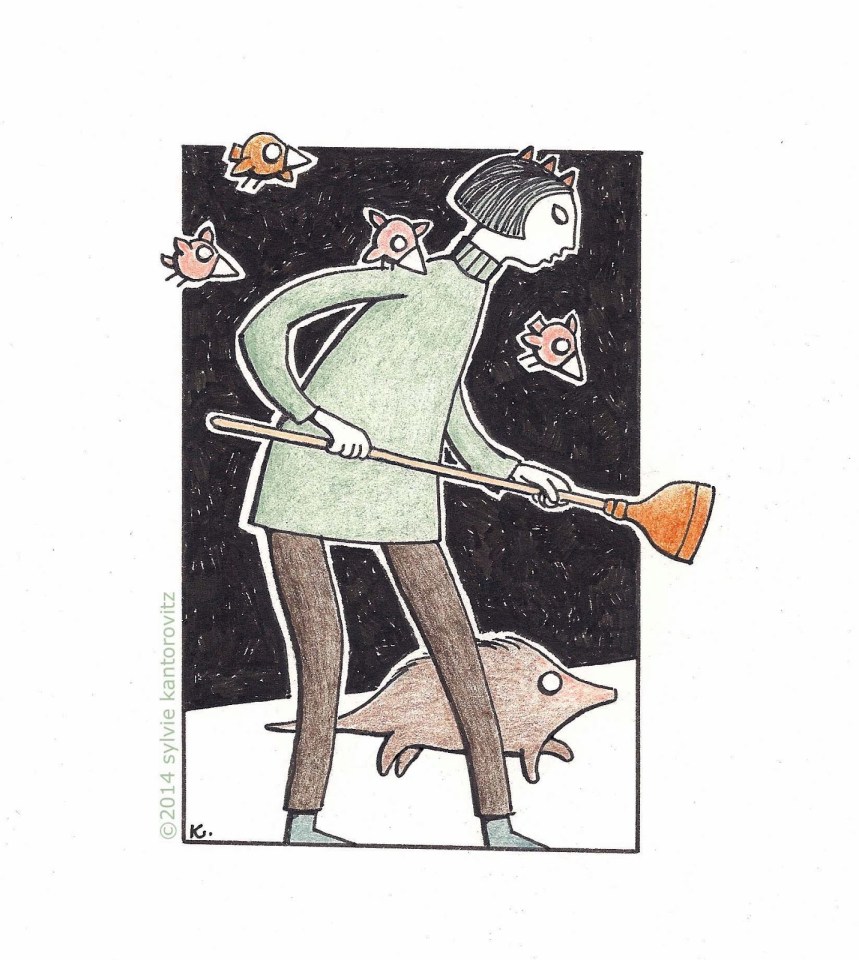
Consider this glorious drawing by Sylvie Kantorovitz, an Albany artist and children’s author/illustrator. Sylvie, an old friend, lives just a couple blocks from me in this homey and humble neighborhood packed with friends. The bunch of us have now spent a couple of decades watching our children get older and wiser while we, curiously, do not. (And yes, as a matter of fact, I’ve ALWAYS been gray.)

Sylvie reads my blog, bless her. She saw my post the other day on plungers, plunger-related tchotchkes and my new, exciting role as Shit Lady. Much to my shock and delight, she responded to it with a plunger-themed drawing on her own blog, where she posts an artwork a day.

This one, “New Weapon,” features one of Sylvie’s recurring characters — a lanky regal sort attended by birds — as she toes up to some unseen onslaught with her plunger at the ready. “Life deals a lot of s*** cards. The Queen attacks and moves on,” says the caption.

I love this. How can I NOT love this? I would love it even if Sylvie weren’t a friend of mine, even if she hadn’t drawn it in response to my blog post, even if I hadn’t written a book with a plunger on the cover, even if I’d never discovered my mid-to-late-life calling as a discombobulated shit-prophet with her head in the stuff. You needn’t be stricken with early widowhood to realize that life will find a way to dump a steaming pile in your path some time or other, be it illness or the pain of divorce or a howling plague of lice and gnats upon the land.

Personally, I have never had to deal with lice. Neither on my land nor on the heads of my progeny; that shit has avoided me so far. (Gnats are another story.)
But Sylvie’s drawing got me thinking, again, about the gift of creation — and the creative urge itself. What better way to cope with the shit we’re given than to make something of it? Something beautiful, affirming, infectious, hilarious, inspiring? Something just a little bit less smelly and repulsive? Anyone who sings the blues knows that shit sounds damn good with flattened thirds. And it should. It’s our most abundant medium, the unrefined ore from which we craft our lives — so we may as well make it interesting. We may as well make it art.

love won’t do that

love never fails
You know how things you see every day can smack you in the kisser in a new way? That just happened to me the other night. And how.

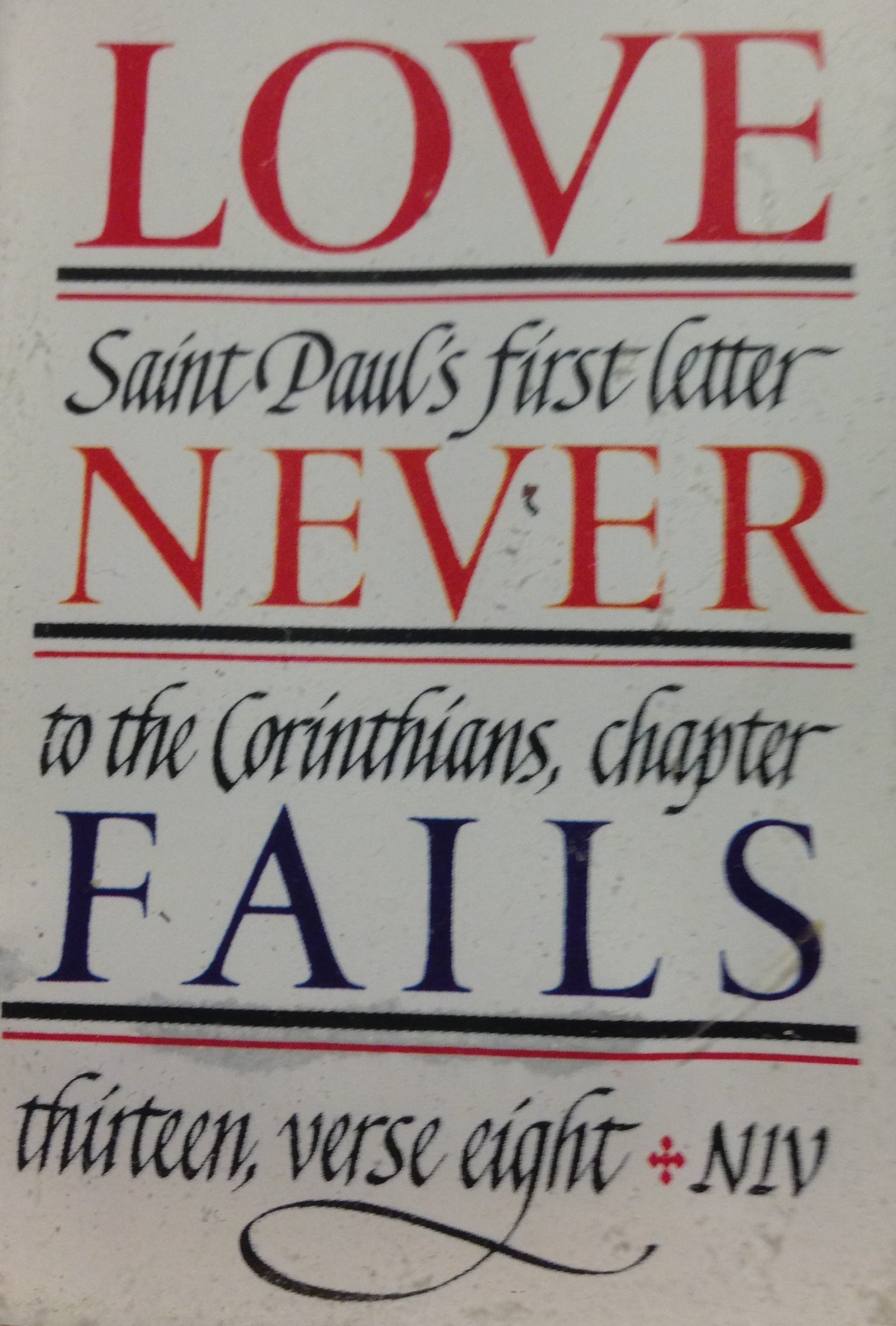
I’d bought the li’l framed knicknack at a dollar store years ago. Stuck it on my dresser. Looked at it every day. Absorbed its message, or so I thought.

“Love never fails.” If I were a biblical scholar, I would have realized that this is often translated other ways. If I were astute, I would have remembered hearing these other translations now and then. If I were only fractionally less spacey, I would have noticed that the remainder of that passage makes a big big big point of the ephemeral nature of prophesies, tongues, knowledge — basically everything in the world besides love.

But, well. I’m not any of those things.

“Love never fails.” So I had always interpreted this line as a testimony to the illuminating power of love, its ability to prevail over darkness. I believed this even though my own love hadn’t prevailed against the darkness that took my sister and my husband. I loved and loved and loved them. I tried and tried and tried.

And yet.

Suicide tests our faith in everything, most of all the force and gift our of own love. The guilt that slams the living in its aftermath springs from a sense of personal failure, impotency, inadequacy. What we could have done but didn’t! How we might have loved but failed!

“Love never fails.” But we’re not called to be successful. None of us is. We’re only called to give it our best shot — to love and love and love, to try and try and try. To hold out our arms when we see someone falling, even if we don’t catch them. Even if we fall, too.

I held out my arms for my sister and husband. Though I failed to catch them, I loved them as well and as deeply as I could, and I still do. My heart still fills with wonder and gratitude at the thought of them both — at the joy of being Lucy’s sister, Chris’s wife. The love I feel neither fizzles nor fades; it only waxes, never wanes.

This is what smacked me, one night at my dresser. It was so ridiculously obvious. I wondered how I’d missed it, all these years. It’s not that love will always heal a wound or stay a final restless act. It’s not about power. The eternity of love — the way it stretches from me to you and us to them, wherever we are, wherever they are, whatever seen or unseen fabric lies between us all — that’s the miracle.That’s the point.

“Love never ends.” It doesn’t.

the philosophy of mac & cheese

macaroni
Mmmm. Mac ‘n cheese. I am not a great cook, but I’m an effective one: i.e., my kids think of me as a great cook, and they will continue in this blissful, innocent, semi-delusional state until they’re a little older and much wiser and have supped at the tables of many and better cooks than I. This is a final stage in growing up, this culinary awakening, and it tends to occur somewhere in the early- to mid-20s. My oldest just cracked that decade herself. So I have a few years to go, still.

Tonight, as I set this dish of baked nirvana before my 13-year-old, he was one happy fella. If only all human needs were met so directly, and simply, and effectively, and with the same gluey profusion of melted cheese. He scooped it, splooshed ketchup on it (yes, when it comes to eating mac and cheese, we are People of the Sploosh), devoured it, scooped out more, splooshed more ketchup on it and then abruptly stopped.

Analyzing the be-splooshed squiggles of elbow macaroni occupying his plate, he noticed a problem. Something was way out of whack with the mac-to-sploosh ratio. He took another scoop.

“I have to even out the balance of ketchup and mac and cheese by adding more mac and cheese, because there was too much ketchup,” he explained.

Ah. Wisdom for life. Finding balance in all things.

“It’s like, if you have too much dressing on your salad, you add more salad to even it out.”

That sounds deep, I told him. There’s some profound truth embedded in there somewhere.

“Yeah,” he said. “It’s like, the mac and cheese is the good stuff in life, the happy stuff, and the ketchup is the bad stuff that happens, the stress.”

He picked up the ketchup bottle and waved it in the air for emphasis.

“So if you have too much stress, you add more of the good stuff to even it out.”

And what’s the good stuff? I asked him.

“I dunno.”

Like, laughter?

He shrugged.

Time with friends?

“Maybe.”

Or maybe we’re forcing this just a little, I said. Maybe the mac and cheese with ketchup is just mac and cheese with ketchup.

“I think so,” he said, and our graduate-level seminar in the Philosophy of Baked Pasta and Condiments came to a swift end.

But I didn’t think we were that far off. The only fallacy in the mac-versus-ketchup thesis is the element of control. In eating, we can dole out the bad and the good, the splooshing and the scooping, without any interference from outside agents; in life, the giant generic bottle of evil splooshes whenever and wherever it damn well pleases. But that only makes the macaroni that much more important, our determined scoops of joy offering our only real counterbalance to the ketchup.

Or not. Probably I’m over-thinking this. Probably it’s just food.

I shut up and ate.