things unseen

36th floor
Periodically, someone suggests that my faith is a comfort to me, and I find myself explaining that, no, it isn’t. And I wonder why. I wonder whether I would feel any differently about anything that’s happened to me so far in this rather eventful life of mine had I experienced it from an angle of atheism — an outlook I last took as a kid. By the time I’d reached my teenage years, I believed in Someone. By the time I graduated high school, I was generically Christian. In my 20s, I felt bound for Catholicism, finally converting in the spring of 1990.

I am not sure, at any point, whether my faith gave me comfort. It gave me a way of seeing the world, maybe, a practiced mode of regarding both the good and the ill. The world was of God, and so was I; that I saw. I also saw that it, and I, were flawed, that everyone is, that all are capable of wreaking horror and beauty both, that tragedy can strike any little life at any time, and that none of us, no matter how closely we look, can ever understand why. Understanding why means understanding the mind of God, and we can’t understand that. We can’t even understand each other. If that were possible, I could crawl inside your brain case and peer outside, blinking at the suddenly altered perspective and suddenly changed light, seeing and thinking and feeling all that you see and think and feel.

But I can’t do that. I can try to do that, and the trying amounts to empathy; and the empathy amounts to love. Maybe that’s all we can manage, the love. Maybe that’s all we can know of God, too. Maybe that’s all we need to.

When I look out from my shortish vantage of an aging mother with whitish hair, I see everything I don’t and can’t possibly know. That’s what my faith gives me: a grasp on the vastness of God’s creation, not just the cosmos, with its order and forces and distant, starry masses, but everything betwixt and beyond it — something darker and less-knowable than even the dark matter and energy that fill most of the universe. From this great Unknown and Unseen comes the joy of loving and the grief of losing, for neither has logic in the known and seen. What I know most of all, in loving God, is the realization that I don’t know anything at all, really. But God does. That’s the essence of my faith, and it doesn’t make burying a loved one any easier. It doesn’t give me comfort. It gives me a posture of alertness, a reason to pay attention, a way to face the agonies and the ecstasies of life so I can move on to the next one. I see so little when I open my eyes. All I can know is that I can’t.

unbreakable

Just a few weeks after my oldest was born, exhausted by sleepless nights but ecstatic with newborn-baby-love, I phoned my mother.

Mama!, I blurted. Mama! I didn’t realize you loved me so much!

“Well, yes,” she replied in her matter-of-fact way. “So now you know.”

Now I know, Mama. Thank you for loving me this way. I had no idea.bebe biancolli

“You wouldn’t. You can’t. No one can know what it means to love a child until they have one.”

And my mother, being both wise and blunt, left it at that. She knew that I had finally gotten the point. And I’m still getting it; I’m still thanking her, though she’s now unreachable by phone; every pang of love I feel for my children takes me back to Mama’s love for hers.

“The umbilical cord is stretching,” she used to say. “It never actually breaks. Just stretches.”

It took me a while to get that one, too. Then I left my baby in a crib the first time. It stretched. Then I left her, howling, with a sitter. It stretched. Then I took her to pre-K, mussing and kissing her sweet head before leaving the room. How it stretched! Then grade school, then middle school, then high school, then a gap year in Ecuador, then college.

Ow.

It’s been the same with all three babies. If you do your job right as a parent, they leave you. What a plain and unavoidable paradox that is, and how important. Today, hugging my second daughter goodbye at the airport as she flew off on her latest great adventure, I felt a tugging at my belly that almost ripped me in two.

But I knew it wouldn’t. I knew the cord, made from the bracing yet bendable steel of maternal love, would neither snap nor wound us. It can’t; it can only strengthen both mother and child, taxing my midriff but tightening our bond. And it will never break.

mama dancing

ups and downs

I used to be afraid of heights. No, that’s not entirely accurate. I am STILL afraid of heights, an immovable fact that I faced at Sentinel Dome at Yosemite this past May. That last, bald, steep approach to the top had me on all fours, frozen with terror, quaking in my li’l Bean hiking booties and bleating/weeping/borderline puking I CAN’T DO IT I CAN’T DO IT I CAN’T DO IT while all three children and a kind young man advised me otherwise. “Yes, you can,” he said. “Just stand up. It’s not that steep.”

He was right. It wasn’t. My fear had the better of me. That happens, sometimes, with heights. So it’s a little weird to admit it, but I LOVE LOVE LOVE roller coasters, the old wooden ones especially, the Comet at Great Escape most of all. I did not always love them. I used to freeze and quake and bleat and weep and borderline puke just at the thought. But 12 or 13 years ago, as I was staring 40 in the face, I decided I didn’t want to shut down and turn all old-biddy-cautious as I got older. I decided I wanted to BE BOLD AND STRONG AND HOWL AT THE MOON, or at least ride on roller coasters occasionally.

The next time we visited the Great Escape as a family, I observed the masses of people who rode the Comet. They stood in line, some of them looking a little nervous; they climbed into the cars; the attendant lowered bars across their laps; they fastened their seat belts; they rode the Comet screaming, laughing and raising their hands; and they returned with their structural integrity intact, most of them looking happy, some of them looking sick, none of them looking dead. This was my key observation: NO ONE DIED. Even the people who had looked a little nervous at the outset didn’t die! And wouldn’t they be the first to, you know, fall off? I would be.

I then observed people riding the two newer coasters with loop-de-loops, the Boomerang and Steamin’ Demon. Same deal. No one died. Given that those amusements actually flip people upside down, freeing them of their loose change and dental work, you’d think there might be a greater chance of fatal outcomes. But nope. None that I observed. NO BLOODY CORPSES ANYWHERE.

This is when it hit me: Most people riding roller coasters don’t die. Granted, some do; I know that tragedy strikes on occasion. One or two people expire per year in coaster accidents nationwide. But millions more don’t. And those millions climb on and buckle up precisely because they know they have a good chance of not-dying. This confidence in not-dying emboldens them. They ENJOY THEIR FEAR. They laugh in the face of death, because, you know, it probably won’t happen! Probably! I love that word! Yes!

Once I realized this, I laughed, too. I, too, felt emboldened. I could ride the roller coaster and be scared bloody freaking shitless, but that wasn’t a bad thing. That was a FUN THING! I could scream my until my face turned blue and distended to blimp-like proportions, hitting high E’s unreachable by earthbound larynges (and yes, I looked it up, that’s the plural for larynx)! Best of all: I could embarrass my children! Hurray!

Okay, so I had brainwashed myself into doing something not-so-wise. But what the hell. Don’t you get tired of being wise, sometimes? And isn’t laughing in the face of death what all of us are forced to do every day, all day long, ANYWAY?

It’s not as though This Life Thing we’re engaged in has any other, better outcome. We’re sort of toast. According to the latest statistics, each of us has a 100 percent chance of dying. I awake each morning and thank God for another day, and I go to bed each night thanking God I made it. The bar is low: if I’m alive, and my loved ones are, too, and I didn’t hurt or kill someone accidentally or on purpose in the preceding hours, coolness. Mission accomplished, baby.

So why not take the ride? Why not say: Okay, right, I probably won’t die today? Though of course it could happen. I could die sitting at home and getting clocked in the head by a dislodged window A/C. Instead, I’ll climb onto this barf-inducing coaster of life. I’ll get nervous going up and howl going down, turning fear into laughter and death into a fine excuse for living. I don’t know what else to do with it. You got any better ideas, call me.

Finally, I append a photo I snapped from my most recent visit to the Great Escape with a combo of offspring. It’s only from the Flying Trapeze, a pretty tame swing ride, but even I’m not stupid enough to whip out my iPhone on the Comet.

weeeeeeeeeeeeeeeeee

weeeeeeeeeeeeeeeeee

oliver sacks, with thanks

IMG_1867
My late sister Lucy introduced me to Oliver Sacks back in the late 1980s. Not literally. She didn’t grab me by the sleeve, pull me over at a cocktail party and say: “Hey, Ame, this is Dr. Sacks,” introducing me to the broad, bald Brit who spent his career spelunking and explaining the deepest recesses of the brain. No, Lucy simply called me up one day and announced, “‘The Man Who Mistook His Wife For a Hat’ — you need to read it.”

I read it. And almost everything else he ever published. After Lucy took her own life in 1992, Sacks became, for me, both an invisible thread connecting me to my sister and a way to understand her better — a way to process all that had happened to her, all the temporal-lobe dysfunction and unremitting suicidality that resulted from it. Reading his accounts of brains and brokenness, I felt closer to my sister, more grateful to her, more awed by her strength and stick-to-it-ive-ness in staying alive as long as she did. I learned about the plasticity of the brain, the strangeness of it. I learned about resilience and fortitude and love. All of that was in his books. All of that illuminated his writing and, as I read it, my own eccentric and rattled brain.

Lucy loved him. So did I. We loved him because he treated people like her — people with serious and mysterious neurological woes — with profound comprehension and compassion, never discounting their humanity for the sake of science, never forgetting that the colorblind artist or the autistic anthropologist or the locked-in Parkinson’s patient had joys, depths, yearnings that fell outside the order and disorders of neurology. Instead, the exactitude of his science informed every case study with an exquisite, clear-eyed pathos. His patients weren’t less human because of their problems. They were more human, more realized and whole.

I read a ton of Sacks after Lucy died, cranking through his best-sellers as well as his less-read works — “Hearing Voices,” “Uncle Tungsten.” I returned to him again in late 2011, when, exhausted by my husband’s six-month descent into insomnia, anxiety, depression and suicide, I gave up on easy explanations — there bloody hell weren’t any — and returned to the voice that had always described our oddball human brains with a reverence, a poetry, that saw beyond the broken bits and found creativity, personality and a fabulous, fertile quirk.

I learned from Oliver Sacks that no brain is a simple thing, that no life is easy. But what beauty lies in them both. What wisdom lies in opening ourselves to their mysteries. What gratitude I owe him for opening my mind and my heart, too.

Learning of his death, I felt as though I’d lost a friend. I’d written to him a few months back, after he published that column announcing his terminal cancer. My words felt grievously insufficient, but I thanked him for living his life and thus enriching mine. I included a copy of my latest book, but not because I wanted or expected him to read it; I only wanted to give him something, although that, too, felt grievously insufficient. He had given me so much.

This morning, I expressed these sentiments again. I hope he heard me, and I hope he hears me now, although I imagine the heavens are noisy with shouts of gratitude. Whether he hears me really doesn’t matter. I have to say it once more. Goodbye, Dr. Sacks. And thank you.

how to cross the street

So I was walking back from Stewart’s, hauling a bag and a backpack full of milk and milk products and chocolate and chocolate products, when I came upon the crosswalk dividing That Side of New Scotland Avenue from This Side. Both sides are generally pretty busy with people busy errand-running, lunch-eating and stroller-pushing — even mid-day, even mid-week, even mid-August. The city painted a crosswalk at the intersection three or four years ago, adding a swell in-street pedestrian-alert sign that’s been replaced a few times after getting run over by resentful motorists or snatched by aliens mistaking them for stick-figure two-dimensional humans, or whatever.

The sign was up when I stuck my toe tentatively into That Side of the crosswalk. I don’t have a death wish. I know enough not to thump my chest, howl I AM A PEDESTRIAN! YIELD TO ME! RAAHHH! and stride boldly into a busy intersection. I’m not THAT stupid.

On the other hand, it peeves me when motorists just, you know, act like I’m not there. Or act like I’m there but I don’t count, or maybe I do count, but not in the way that cars do, and definitely not under THESE circumstances, i.e., any circumstances involving IMPORTANT THEM and THEIR IMPORTANT CARS. And what do I think I’m doing anyway, moving around a city of any sort without the aid of internal combustion?

Drivers are getting better at stopping, I must say. They stop most often when I try to make eye contact and wave at them friendly-like, as if to say, “Hi! I’m here, and I would like to cross the street without dying and/or spilling my milk and chocolate products!” This seems to either humanize me or guilt them into submission, maybe both. Then, to express my profoundest gratitude, I issue them an even friendlier-like wave that says, “Thank you SOOOO much for pausing in your busy day to let me pass without a life-crushing incident!” They smile. I smile. Happiness all around. Humanity and civility prevail! Hurrah!

Usually, the drivers who don’t let me cross just flat-out ignore me. When I try to make eye-contact, they resist, turning their square jaws and steely eyes straight toward the horizon (or where the horizon would be, if we had such things around here). In return, I smile broadly in gratitude and wave as they pass. I love love love doing this to people. They look soooooo confused. Their poor widdle wide-eyed faces! They ask so many wondewing questions! Such as: “Waaaaaah?” and “WTF? Did that Weird and Insignificant Walking Thing just wave at me?” and “Do I know her?” and “Did I do something nice to her that I don’t recall?” and “Holy holy SHIT! Is that my Aunt Brenda? Have I forgotten what she looks like? Does she live around here? Is she that weird? Does walk?”

It is so much fun. I can’t recommend it highly enough.

And so, on my most recent walk home from Stewart’s, I took a hesitant step into traffic and tried for eye contact. Cars whooshed past. I waggled my right leg. More cars whooshed past. I waggled my leg a little more, kick-line style, accompanying this chic move with a jazz hand and a fetching smile. Yet more cars whooshed past.

Finally, I caught the eye of a woman driving a BMW. She looked at me! Victory! I smiled! Another victory! I waved my hand as if to say, “Beemer Lady, hello there! You’re soooo nice! I can tell! Please stop for me! If you let me cross the street without killing or maiming me or my dark chocolate Milanos, I will love you forever! I will praise you to the heavens! I will tattoo your name across my forehead! Across my children’s foreheads! Right now! Watch me! Pass the ink!”

And do you know what she did? You don’t. There’s no way you could know. She DID NOT LET ME CROSS, although I’m happy to say she didn’t kill or maim me, either. Instead, as she whooshed through the crosswalk, she gave me a dismissive backhand wave — sort of a lazy, whole-handed flip-off, as though the entire appendage functioned as Just That One Critical Finger, which she honestly couldn’t be bothered to extend — and rolled her eyes with a little twitchy grimace of annoyance. I repeat, she ROLLED HER EYES. As in: “Puh-LEEZE. I can’t be bothered. We BOTH know you don’t count, O Weird and Insignificant Walking Person. As if! I’m so bored by you and your groceries, I want to vomit.”

In reply, I did not smile. I did not wave. Then again, I did not give her the finger, either, or even a whole-handed approximation of same. So I think I behaved pretty well, under the circumstances. I didn’t even stick out my tongue at her tailpipe! Seriously! Be impressed. I am.

Anyway, there was traffic behind her, and I still had to get to This Side of the street. I stuck out my foot again and looked out, hopeful. The very next car was a shiny black SUV driven by some young dude, and I caught his eye. He let me cross.

I smiled and waved. He smiled and waved. Humanity and civility prevailed.plunger


breakdown

FullSizeRender (1)Everything I own is broken. I am not exaggerating. When I say everything I own is broken, I mean EVERYTHING I OWN IS BROKEN, including the eternally clogged drain, the blitzed-out light over the upstairs toilet and the malfunctioning Dwight Schrute bobblehead that wouldn’t actually bobble, just flop sadly over in existential despair, until I wadded up paper and crammed it into his head. So I guess it technically isn’t broken any longer.

But my cars. Holy shit. You know how I hate them suckers, right? How they just break down uninvited, get into accidents for the heck of it and poop out muffler insulation that resembles cheapo wigs? Well, let it be known that that’s been happening again. In a big way. A big, big way. Involving THE IMPENETRABLE KAFKAESQUE NETHER-ZONE OF INSURANCE-COMPANY CONVERSATIONS.

Plus I just paid, like, a million dollars to replace every last bit of one entire Honda after it threatened to kill me on the drive to work. I’m serious. I brought it in immediately to the nearest possible shop, and now it’s like a whoooole new vehicle. You know that Richard Scarry book where Mr. Frumble takes his pickle car in for repairs and it comes back a hot dog, or something? This is like that. Exactly. I swear.

Also, my dryer broke. And my piano needs fixing. I could go on (NO! NO! NO! howl all six of my readers) but won’t, mainly because it’s an endless list, and I could be here all night, and I still need to exercise and shower and practice the violin and watch the first “X-Files” movie with my son. But also because, well, isn’t this how it works, this complicated gizmo of life? There are too many moving parts to it, too much occasion for cosmic chance. At some point — at most points, actually — it’s sure to break down.

So am I. I’m broken, too. I don’t just mean the mess in my knees or the ever-increasing hyperopia of my eyeballs. I mean I’m broken inside, but I don’t know who isn’t. As a person of faith, I believe we’re born with a sense of order, a yearning for perfection, that amounts, I think, to a kind of metaphysical homing signal. On some level we KNOW things are better somewhere else, more seamless and loving and less prone to breakdown, and we try like crazy to replicate that here.

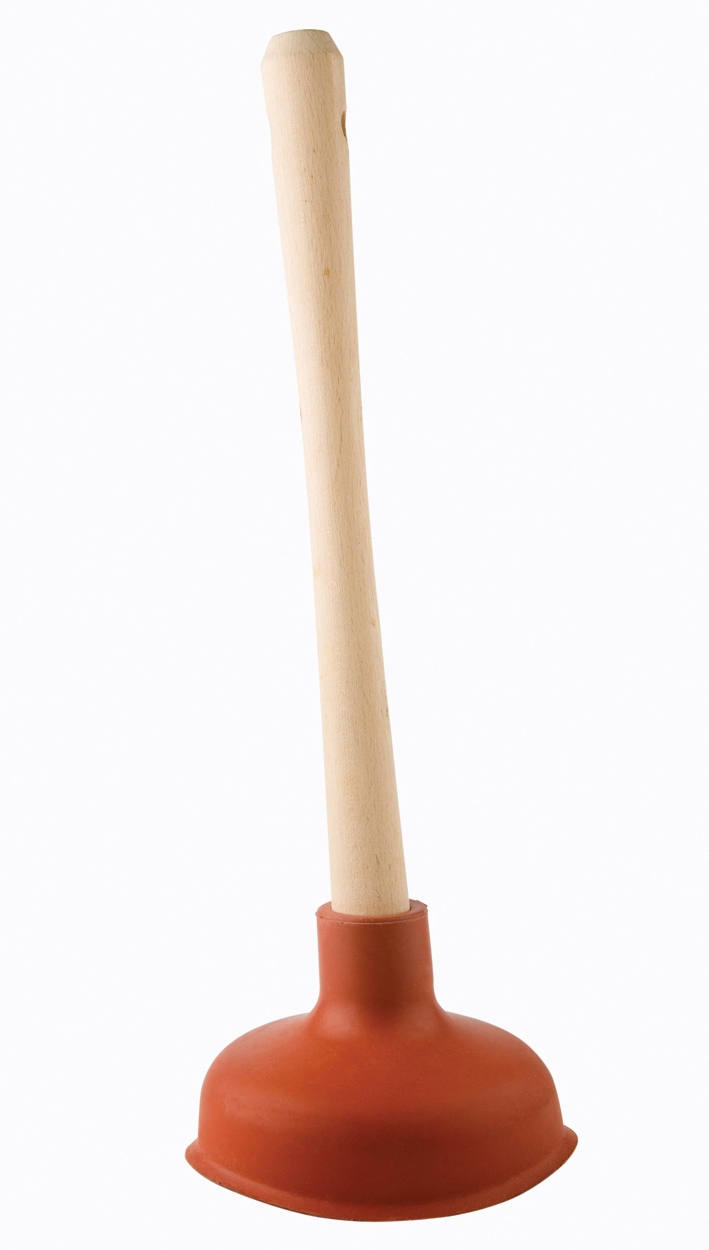
Of course we can’t. Of course we can’t stop trying, either. That’s what plumbers are for.

trump in the lunchroom

The whole flap over Trump’s latest Trumpism has me thinking about middle-school lunchrooms. It’s like we’re all trapped at a table with our half-eaten mystery meat and the kid who won’t shut up. You know him (or her). We all do. He’s a show-off. He’s mean. He bad-mouths people behind their backs, dishing his snark at the fat kid with the butt crack, the skinny kid with the zits, the girl with the crooked bangs, the quiet boy who draws cartoons in a corner and, in a nasal whisper as she walks past, the lunchroom aide with the cheap dye job and the shuffling gait of a lifer.

We’re all too mesmerized by this kid to object. We can’t even look away. His air of relaxed authority and entitlement — and don’t all mean kids have that? — suggests that everyone everywhere ought to be listening, no matter the inanity or offensiveness of the content. I’ll never forget the sight of one such mean kid, a rawboned girl, holding forth on the playground with her fist on her sharply jutting hip. I don’t remember her name, or anything she said, or about whom, but I remember the crowd of girls huddled around her. I remember the expression on her face: snotty. I remember the angle of her elbow: 90 degrees. I even remember the color of her bell-bottoms: gray. And I remember that none of us moved.

So when Trump got in trouble, post-debate, with that remark about Megyn Kelly bleeding from her “wherever,” I was a little surprised. For one, I think I might — MIGHT — actually believe him when he says he didn’t intend it as a comment on her menstrual cycle; the “wherever” sounded more to me like the inexact blah-blah-blahing of someone who’s talking too fast for his brain. Also, after all the hateful, outrageous and objectifying remarks we’ve heard from him so far, THAT’S the one that finally incites widespread outrage? Talking about Penny Period? THAT gets him booted from the lunch table and disinvited from the RedState Gathering (and does anyone else appreciate the rosy irony of the name?).

And then I remembered those old tampon ads with clips of women in flowy white dresses intercut with shots of sanitary products being doused in crystalline blue liquid (not ferrous at all), and it hit me: EVERYONE IS GROSSED OUT! THAT EXPLAINS IT! It’s the lunchroom factor! If any woman learns anything from middle school, it’s that you do not talk in public about menstruating. You do not. Men don’t want to hear about the real-world phenomenon, much less talk about it (another reason I’m inclined to believe Trump), and women don’t generally raise the subject unless they’re in the ladies’ room and in sudden need of a Tampax. Outside that restroom, no one wants to associate bleeding with female plumbing. The most anyone ever does is make cracks about PMS, but (news flash) all the fun hormonal stuff occurs BEFORE the onset. That’s why they call it “pre.”

Maybe Trump intended the remark as outright misogyny, maybe not. He’s said plenty else that might and should have sent the embarrassed middle-schoolers shrugging away, cafeteria trays in hand, in search of another table — but nothing so far has sparked this type of revulsion. Whether he meant it or not, he introduced menses into the national conversation, and the lunchroom is officially squicked out.

extrovert, introvert, ambivert

People are always telling me I’m an extrovert, and I’m not. This happened again the other day, and my response, as usual, was: NOOOOO! I’m not! I swear! I only seem like an extrovert!

OKAY, all right, so I write and blab in public about all of my deepest thoughts and my most horrifically painful tragedies; I’ve written two, you know, books devoted to said tragedies;  I did a TEDx talk and a “Moth” story on them; and I am ready and willing to discuss them with any total stranger who approaches me in almost any context. Almost. I also happen to talk a lot. A shitload, really. Total windbag. I am more than capable of being stupidly loud, even when I shouldn’t. I like meeting new people, I enjoy parties, I’m forceful in an argument, and I don’t slink away quietly from crowds.

But none of this means I’m an extrovert, because I also savor long stretches alone to recharge my batteries, though the realities of my life mean this only rarely happens. But when I’m able, I am perfectly happy to spend time in my own head, whether I’m reading contentedly on the porch or spacing out, my unfocused eyeballs twirling like gaudy carnival rides while my body blobs bonelessly in a slump. I do that a shitload, too. Just ask my offspring, who’ve been known to jump out and down while waving their hands maniacally in front of my face, shouting MOM MOM MOM MOM MOM or saying outrageous untruths just to test me, most of them involving the construction HEY GUESS WHAT MOM I’M _____ (fill in the blank).

though i suppose only an extrovert would upload this

though i suppose only an extrovert would upload this

Maybe I’m an extrovert who feels like an introvert, or an introvert passing as extroverted. Or it could be I’m an introvert turned outward: someone who popped out of the birth canal with her head stuck up her moist little newborn tuckus only to have the hands of God and fate slowly, if not always gently, yank it free. As a kid I was profoundly, agonizingly shy — quiet, klutzy, pigeon-toed, unsure, never one to speak out in class, only ever at ease around my parents and older sister or my few close friends. I perceived the world and its confident occupants from within a chubby bubble of insecurity and confusion. I sometime spent hours — whole days — alone in the yard or the woods behind my Connecticut house, making little forts inside hedges and stands of bendy saplings, hoarding leaves and rocks and knick-knacks in holes dug in the ground, talking to myself, daydreaming constantly, lying on brittle grass or swinging on branches and snuggling the roots of my favorite tree. It was a Norway maple, and its name was Sweetheart.

But then I enrolled at the teensy all-girls school where my mother taught music, and I began to play sports — soccer especially. I found that my klutziness did not preclude athleticism, my pigeon-toed-ness did not prevent me from disco-dancing (with imported boys), and my shyness did not prohibit me from speaking up in classes so small that I was, on occasion, the only student. By the time I got to college I’d figured out how to talk in larger groups. I took a public-speaking class. I went to frat parties and acted drunk, even though I wasn’t.

Then, in 1992, my childhood family started dying, and I started talking and writing about it. I kept talking and writing after my husband died in 2011. None of this was my idea. I didn’t set out for a side-career in gut-spewing grief confessionals. It just happened. Life happened. But I didn’t change inside; I only learned how to live on the outside, how to face it rather than fear it, navigate it, find joy in it, fill myself with a new kind of energy from its stores.

So, no, I’m not an extrovert, but I suppose I’m not an introvert any longer, either. Better to call me an extroverted introvert, an introverted extrovert — an “ambivert,” as one personality test labeled me. “The Chameleon,” pronounced another, although that makes me feel like a slimy and shiftless master (matron?) of disguise. No test so far has called me a “bivert,” “panvert,” “omnivert,” “megavert,” “supravert,” “super-de-duper-vert,” “hermaphrovert,” “wowza-vert” or “who-gives-a-vert,” but believe you me, I’m waiting for it.

Or, hold on! I know! Here’s an idea: Maybe I’m just a human being who’s had one heck of an eventful life, and maybe it’s had some lingering effect on me and my approach to the world. It may also be that labels are USELESS AND SIMPLISTIC CRAP, and I should ignore them, slinking timidly away into my fort made of saplings. But only after I’ve blogged about it.

mother knows best

*that* doesn't look like a butt.

*that* doesn’t look like a butt.

Mama had her notions. Yes, she did. She was a smart lady, a world-class violinist, a Barnard-educated philosophy student, a voracious reader, an expansive thinker, a sharp-as-a-tack witness to human behavior. And she was always spouting opinions ON EVERYTHING. Many of these opinions made sense to me, if not at first, eventually. As in: “There’s such a thing as being so open-minded that your brains fall out.” And: “Every teenage boy has a hollow leg. He fills up his stomach and just keeps going,” which, now that I am responsible for the housing and feeding of one such person, I have learned to be true. She also said a few things that still strike me as somewhat harsh: “When your kids enter puberty, you just want to take them out back and shoot them,” and I’m profoundly grateful she never carried this out herself.

And then there were her mega-mondo-bizarro opinions, her beautifully wacky theses based on either A) questionable science, B) outright quack science; C) science she swore to be mainstream but could never actually cite when questioned; and D) her own rather stunningly insightful observations. Included the last category, which I’ve mentioned before in print and will never tire of repeating, was her First Theory of Faces governing the waning careers of certain regional TV newscasters: according to Mama, these people never hit the big time because their faces came, in the course of aging, to resemble buttocks. For all I know, she was right. I had no better theory.

Also included in category D) were a couple of hypotheses that (I am flabbergasted to now report) I found to be correct. Among other things, Mama SWORE that earlobes kept growing into old age, and yes, it turns out they do, although I must note that she was wrong when she claimed they grew after death, too. I was also a  little skeptical of her theories governing malice and human physiognomy — her Second Theory of Faces — which postulated evil in the upside-down portraits of famous people. According to this one, you could see the despotic malevolence in someone’s eyes if you just flipped the photo on its head. (Try it with Hitler. Or don’t. He’s pretty ugly either way.) So far, science has not backed her up on this one. You see anything that supports her, please send me the link.

But Mama also SWORE that early homo sapiens must have had sex with Neanderthals at some point, and this one always made me laugh. HA HA HA MAMA, THAT’S HILARIOUS, I’d say, at which point Mama would cock her head, jut her chin in her saucy little way, mention someone we both knew with prominent eyebrows and pronounce: “Come on. X has a brow ridge. X is proof. One of X‘s ancestors mated with a Neanderthal!”

Sure, Mama! Ha ha ha! Your Third Theory of Faces! Whatever you say!

And then, holy human evolution, it turned out she was right. Time for me to check the mirror. Could be my face looks like an ass.

correction: that was the wig that *wasn’t*


WEIRD UPDATE TO WEIRD POST:

I learned something new, people! I learned that mufflers, ON THEIR OWN, grow hair like Donald Trump’s! They do! And then, when they get too old to drive, they spit it out their undercarriage in shiny, regurgitated whorls of toupee-like ejecta! Yup.

Thanks to one of my children’s former band teachers, who corrected me politely on Facebook, I now comprehend that, in fact, it’s just this hirsuite internal wrapping of fiberglass that makes modern mufflers muffle.

Apparently, mufflers puke up wigs when they get all holey. And apparently I need a new one.

You don’t believe it, just click here for a disturbing array of hairy automotive strangeness.

Be warned: that’s some scary shit. I’m surprised such aberrant muffler behavior hasn’t inspired a horror flick of some kind. If they can make a movie about a serial-killing car tire, which I was lucky enough to review in my former life as a critic, why not muffler hair? You see my point? Imagine the combovers!

Hmmm. Maybe I’ll write it.

ORIGINAL WEIRD POST (i.e., that was the wig that was):

Okay, so this is weird.

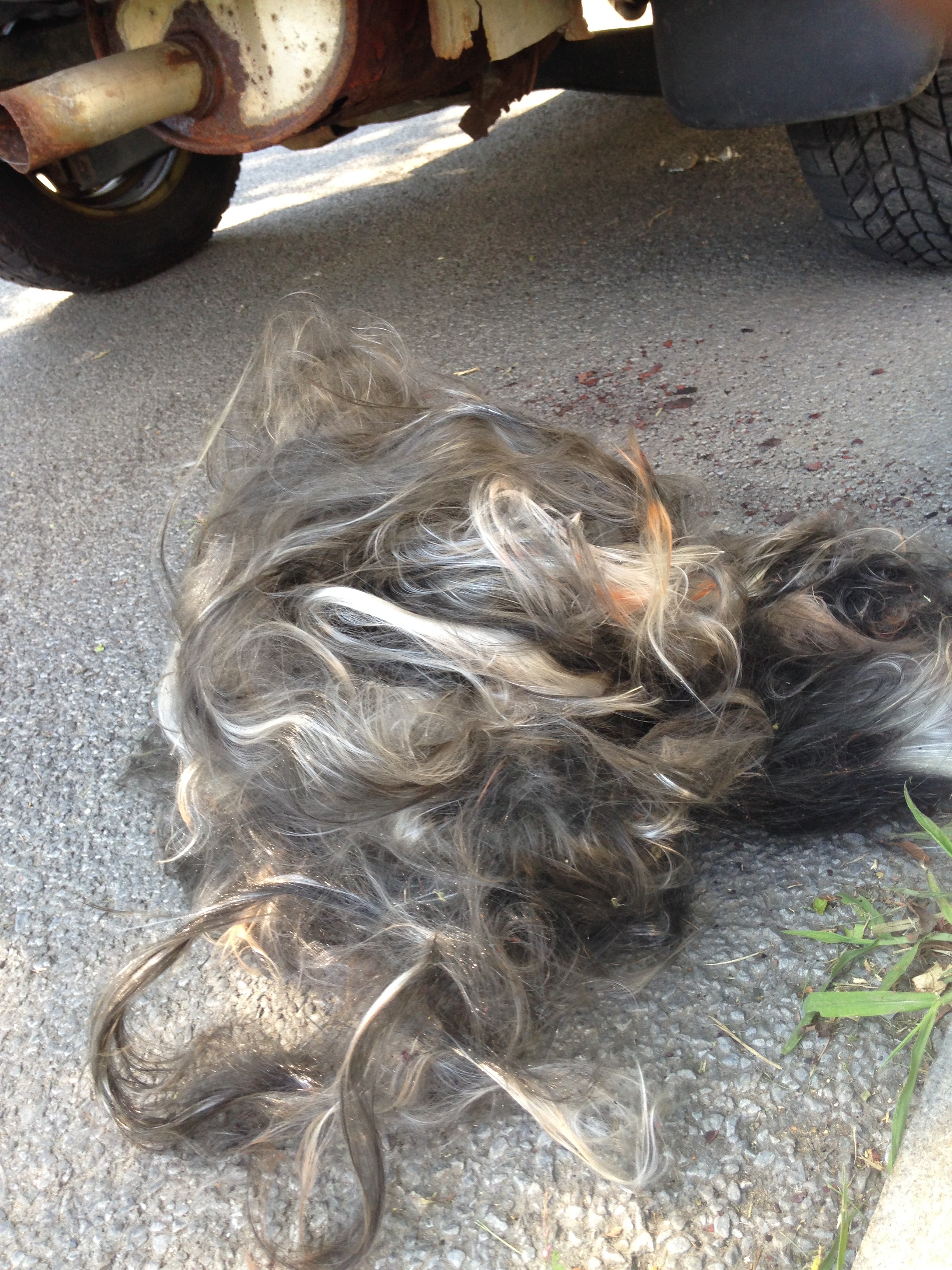
The other day, after pulling up in front of my house in the way-way-older of my two blue Hondas, I casually glanced at the rear end and spied something gray and hairy, kind of like my head, draped from a hole in the muffler. It looked like the fur from the belly of a long-haired cat. Or maybe a luxuriously pelted fox. Or a raccoon. Or a grandmother. Shit! Was that a ponytail dangling out of my rear? Had I actually run over a sentient being unawares and sucked it up my exhaust?wig

I got down on my knees and examined the bushy extrusion, first with my eyeballs and then, tentatively, with my fingers. I took a deep breath. THANK GOD it wasn’t human, or even mammalian; it was some cheapo plasticky silver fright wig streaked with pinkish highlights. The ensuing twin revelations (Yay! I didn’t kill anyone! and What a vile thing to put on someone’s head!) were quickly followed by a third, more inquisitive thought (What the fork was that doing in the road?), which led to my fourth and final conclusion (Shit! I better get that thing outta my muffler before it spontaneously combusts and I’m consumed by a rolling fireball!).

With this last, forceful imperative in mind, I yanked at the first draping lock of hideous faux hair. Out it came. Out more came. Out came so much that I started to worry that the neighbors would emerge from their homes, watch me surgically extracting hair from my car’s underbelly, and call the police. But this worry did not stop me on my quest to de-wig my aged Honda. I pulled, and I pulled, and I pulled, tugging at that fibrous mass until I had, on the pavement beside me, a giant, swirling barf-up of wiggy plastic filaments.

I must say, it creeped me out. It looked like it might be a sentient being unto itself. Would this puzzling vortex of hair start talking to me? Would it demand to be fed, like the Audrey 2 in “Little Shop of Horrors?” Would it sprout legs, put on a tie and run for president?

Naturally, I whipped out my iPhone and snapped a picture.

I have no great wisdom to offer, here. This is not going to be one of those blog posts where I reflect oozily on life, death, mental illness, grief after suicide or some fun combo of all four. I’m not even going to try to draw profound conclusions about the weirdness and mystery of life,  the peculiar and surprising happenstance that dots our daily progress. Nope. This is only a post about THE WIG THAT GOT STUCK IN MY MUFFLER THAT DAY, and that is all.

I swear that’s it. Nothing more. No deeper meaning anywhere.

Besides, I threw it out.