life, death, goldfish

image
At work the other day, a message flashed on my phone. I happened to see it. I don’t always; I turn off the chime while laboring away in the newsroom and only check now and then to be sure my offspring aren’t in distress somewhere, incapable of phoning but still, somehow, able to whip out their thumbs and compose pithy tele-communiques with or without the aid of autocorrect. They could be floating down the Hudson in a cereal box, and I’d get a text that says “headin downstrm to NYC love you.”

But the other day. I checked my phone, and there it was: a text from my son announcing the death of our goldfish. You might not remember our goldfish, and even if you do remember it, you might not care, scratch the “might,” but this is the sad orange small finny creature who remained anonymous on a shelf in our kitchen until, back in December, I ran a poll asking readers to name the poor thing. And then they (THEY means YOU, and YOU KNOW WHO YOU ARE) named it Sushi. Which is clever. Which is also kind of sick. Which is why my children summarily rejected it. I am sorry to say this, or maybe I’m not sorry, you’ll have to guess which, but no one ever, ever, ever called him “Sushi.” We preferred “Jesús.”

In any case, he’s dead. This is not happy news, but the text? The text is a beauty — trenchant, informative and compassionate, its five words
conveying all the necessary intel and profound emotional depth. “The fish is dead. Sorry.” Seriously, what else can be said? About this small death? About any?

My response isn’t worth discussing. But his reply to that text was, in its way, an equally crisp and composed metaphysical discourse on life and death, on the brevity of one and the inevitability of the other: “He lived for like 5 years. INSANE.” It took seven words to say it instead of five this time, but still. It’s a feat of reflective and incisive spiritual commentary, and not merely on the lifespan of the Carassius auratus auratus. This should be our response to every birth, every life, every gift in between: Life is always INSANE, a crazy boon and boodle no matter how long it lasts. When it ends — whenever that may be — we should count up our blessings like pirates with a stash of plunder. And we should be doing that all along.

My son the philosopher! Give him a long white beard, and watch him scratch his chin!

As for Jesús, may he rest in peace. He was a good fish. Sorry.

gotta hand it to me

hand
I write shit on my paw. Left one. Reminders. To-do lists, when I don’t trust whatever pathetic crumpled scrap I’m bound to lose. I have written shit on my paw for as long as I can remember, and for this I blame my late mother, because she wrote shit on her paw the whole time I knew her and presumably decades before. When I was too small to write shit on my paw myself, I remember Mama writing it on hers, although she did so with much neater and more artful Depression-era-perfecto handwriting than I ever managed with my late-late-late-Boomer indecipherable dying-chicken scratch.

When I was a kid, fretful adults suggested I might get “ink poisoning” through my skin, and even then I knew enough about dermatology and simple animal biology to realize that skin wasn’t actually that porous or we would all bloat into giant, flesh-colored, distantly hominid-shaped water balloons each and every time we took a bath or walked through a sprinkler or something. So I tended to discount this as a possibility.

Most days, the real estate between my thumb and index finger is littered with such quotidian directives as: SHOP and CLEAN (which I ignore) and GO TO BANK (which I can’t afford to ignore), as well as reminders to CALL THIS PERSON and CALL THAT PERSON and PAY THIS BILL and PAY THAT BILL, plus the more all-encompassing, borderline-hysterical PAY BILLS!!!!! (with an implied, unstated DUMBASS!!!!!). Occasionally I scribble something down that’s a bit too vague or telegrammatic to be truly helpful, such as the urgent SHIFT!! I penned on my hand one afternoon last week. I’d intended it as a reminder to sign up for a weekend news rotation at work, but all I could do, the morning after, was to stare at it blankly and ask: What what? Which gear?

The idea behind all this auto-graphical list-making is to help me remember things I forget, which is a challenging and also somewhat hilarious prospect, because I forget EVERYTHING. I am not exaggerating. If my hand were big enough to accommodate all the shit I might lose track of on a daily basis, I would have no room on my body for anything else. Think about that for a minute. No, wait. Don’t.

oh, why not

I’m pulling into the Price Chopper on Madison Avenue, right? And it’s Saturday evening, right? And I’m just planning to bolt inside, buy a couple bags of Empire apples (accept no substitutes, my friends) and a few other critical items, right? And then head home to the chillenz. So there I am, nosing the car into the P-Chopper lot, when I see this guy crossing in front of me on the sidewalk: heavy-set, maybe 60-65, with a labored gait and distracted expression, wearing a baggy black t-shirt that shrieks one word, billion-point type, all caps:

WHY?

I am so startled by this question that I almost roll down the window and shout after him: WHY WHAT, SIR? Something prevents me from doing this. Maybe I’m in a hurry; maybe I’m not in a mood to engage with strangers; maybe it’s the look on his face of intense interior dialogue, which suggests he’s got enough on his plate without some weirdo random lady grilling him about his choice of frock. But I instantly regret not asking him, because he and his loudly inquisitive t-shirt haunt me into the supermarket, down the produce aisle, past the cans of crushed tomatoes and all the way into the bakery.

What’s he asking, exactly? Is he positing some philosophical conundrum? WHY ARE WE HERE? Is he pondering imponderables sages have pondered since the dawn of time, such as WHY DO MEN SPIT IN PUBLIC? and WHY DO FOOLS FALL IN LOVE? Or is he challenging the souls with whom he crosses paths to question their own beliefs, choices, preferences, foibles, prejudices? WHY do you believe it’s okay to run red lights? WHY do you insist on eating marmalade when everyone else considers it slimy and noxious? WHY do you care so much about celebrity break-ups? Most importantly, WHY is there a booger dangling from your nose?

The funniest thing about this t-shirt, aside from the dead-serious expression of the fellow wearing it, is that I had decided I was all done with WHYs. I was so totally over ’em. Having grappled with the damned squirmy things for the last few years, I had decided — by the time I put the quadrillionth obsessive “final and I mean that (ha ha ha)” edit on my book — that we’re well and truly better off without the suckers, at least when they’re not challenging the behavior of certain elected officials. (WHY can’t Congress get its shit together?)

As a way of coping in the aftermath of life events, WHYs get us nowhere. They keep us stuck in the past. They only spin the wheels inside our aching squeaky crania, keeping our minds fretful and inward-oriented when re-orienting outward is our best salvation. True, we can sit barefoot in our kitchens, sobbing pathetically into our marmalade, but we’re always better off heading outside and talking to strangers — even the distracted ones loping past Price Chopper in cotton loungewear.

And then we’ll be tempted to ask: WHY are you wearing that meddlesome t-shirt? I only wish I had.

situational determinism

I am not good at owning things. In truth I am terrible at it. My late husband: he was good at it. No sooner did an object come into his possession than he found the ideal place to store it AND actually stored it there AND put it back after each and every time he used it.

This was true of every ever-loving thing he ever owned, from socks (YES, SOCKS) to the Sawzall, and I always knew that about him, and I especially knew it from the moment during our first date when I laid eyes on the trunk space of his ’85 Corolla, but I knew it even better after he died and I started Using Things and Then Tragically Failing to Put Them Back Where They Belonged. Once that happens, once the tragedy sets in and the things begin to accrue into large-scale crap formations, let me tell you something: they never, ever go back. Instead they just sit there, adrift in the universe, taking up room in the wrong spot.

When Chris first visited me at my parents’ home in Connecticut, he observed heterogeneous piles of things in peculiar disparate locations and asked, as was his wont, about each one. “Amy?” he’d query. “Why is there a giant saucepan sitting on the porch filled with moldy cat food?” And I’d reply, I SERIOUSLY HAVE NO IDEA. And he’d ask, “Well, shouldn’t we clean it up?” And I’d say, NO, PROBABLY NOT. And he’d ask, “Well, why not?” And I’d reply, BECAUSE MY MOM WOULD HAVE A BABY, when in fact my mother had long since lost interest in and facility for such an enterprise.

At this information Chris’s brow would crinkle with sad perplexity and he would walk away, only to return later when no one was around, often in the dark of night in a skin-tight cat suit, on a stealth mission to clean up and normalize the porch. And my mom would quietly have a baby. Out of earshot of Chris. Because she knew how much I loved him. But to me, she’d heave a sigh and say something about the Saucepan Being Out There For a Reason or, if he had gone ahead and reorganized the kitchen pantry, she’d add something about Not Being Able to Find Anything Any Longer. The pantry! Which always looked like a 14-megaton bomb had detonated in a pasta factory!

Chris was so impressed by my parents’ attitude toward the house and all its contents that he invented an entire school of philosophy to explain it: Situational Determinism. This is not to be confused with Situational Determinism in economics, which Google tells me has something to do with some guy named Lastis (didn’t I almost fail economics in college? and why the hell did I take it, anyway?). Unlike the Stoics (as if), the Platonists (please) and the hairy German pessimists (though there’s a giant saucepan on the porch for them, too), Situational Determinists maintain that if Something exists in a certain State, it exists because it exists in that State, and it will continue to exist in that State because it already exists in that State. So the saucepan sits on the porch because the saucepan sits on the porch, and so we may conclude that the saucepan will always sit on the porch.

Occasionally I sense within myself the dangerous stirrings of a Situational Determinist. A stack of crap amasses in some corner of some room, and soon enough I fail to see it. Soon enough it exists because it exists, and therefore it will always exist, and therefore I am screwed. My only hope is to not own crap to begin with — and to get rid of as much of it, on a regular basis, as I can. Some of it I give away; some of it I bag and move to the curb on trash night, trusting that the garbage collectors, at least, will see it and whisk it away. Good thing they’re not Situational Determinists, or public hygiene would suffer. Someone should give them a raise.

don’t kick this

What a strange thing, to be alive. To be conscious and yet unknowing. To shove forward into the formless dark believing light must lie somewhere ahead, cloaked and scattered by obstacles that absorb our attention and sap our faith.

But shove forward we do, not out of virtue or spit or strength but something primal and undeniable, something that resists all reason and every hard-won past experience that tells us we shouldn’t. Habit. We live out of habit. And thank God that we do, because habit puts us to bed each night, habit wakes us to the sun each day, habit has us flossing and toiling and driving on the right to avoid collision and doing all that we do because we’ve always done it, we’ve always flossed and toiled and driven on the right, and our worlds only function if we do it. Even in the thick of impossible pain.

Habit got me and my kids through the first 24 hours after my husband’s death. It got us through the first week, then the first month, then the first year. It’s gotten us all the way through two years and eight months (almost), and it’ll get us through the next year and the next year and every year thereafter. It gets. It goes. We move. And as we move, only if we move, milling along through force of habit, we run across strange new joys. Habit can yield miracles, if we let it.

Because hoping and loving are habits, too. Often we do it and feel like fools. Hope for the wrong thing, love the wrong person at the wrong time, feel like a boob. KICK THOSE HABITS, the Ego barks at the Id. And don’t we all want to? Don’t we all wish we could? But then the drop-kicked habit yields another kind of pain, the ingrown agony of never loving, never hoping, never living. Better to love and risk being wrong. Better to hope as a rebuke to despair, as a veiny middle finger pitched into the darkness. Better to live out of habit, because only the habit can bring us to light.

good morning, grandma

I had ten minutes to kill last night. I was sitting in my car, waiting to pick up my daughter and ferry her to an event downtown, and I was, as the Brits say, knackered. Why they say this, I don’t know. But I was short on sleep. My eyeballs sagged and squished and spilled out of my sockets with fatigue; ugly sight. Not wanting to scare anybody, I dropped down the car seat, lowered down my eyelids and tried to doze.

I was maybe two minutes into this endeavor when I heard a flock of kids walk past, flapping their lips about nothing of interest to me. But apparently I was of interest to them. Apparently the sight of a snoozing, hoary-headed 50-year-old lady-thing reclining in an electric-blue Honda was too much for this group of proximate man-lings, who felt compelled to express their interest with the aid of an ancient and useful term that I’ve been trying to keep off of this blog. (I want you to know I made no such valiant efforts at self-censorship when writing my batshitty little book, or, more recently, when I burned my elbow cooking this evening. And sorry, I am not going to attempt to explain how One might burn One’s elbow cooking, though it’s safe to say it demands the flexibility of a world-class gymnast. But you’ll just have to imagine that for yourself.)

So the bevy of boys whooshed past my car. I sensed their presence. I smelled their testosterone. I heard their voices, though I cared not what they said. Until they started saying things about me. To me. Colorful, pithy things.

Things like: “Look! She’s sleeping!” (Which they’d obviously never witnessed before. No one they know EVER does that.)

And: “Ha ha ha!”

And: “Hey! Wake up!”

And again: “Ha ha ha!”

And finally: “Wake the (insert word or related Dutch cognate here) up, Grandma!”

With a conclusive: “HA HA HA!”

And then they walked away, leaving a cloud of testosterone behind them.

Before I go any further, I want to be clear on a few points. One: I am not anti-testosterone. If I were, WOULD I HAVE CHILDREN, PEOPLE? Second: I am not anti-teenager. I have a few of those myself, I’ve known many such creatures in the course of my life, and I once spent several years in very similar embryonic state, although I’m pretty sure I never tried to rouse a gray-haired lady from a power nap, with or without the forceful slang. Third: I am not anti-cursing, though I’m guessing I didn’t need to reassure you on that point.

Fourth: I really didn’t care. In the slightest. I wasn’t offended. In the slightest. I wasn’t sure why until it occurred to me that, hey, I might well be a grandma at this stage in the game. People are. But until that moment, until that pack of hormone-spritzing guy-lets strutted past my car, stating the obvious with a nice, fat, vulgar flourish, I hadn’t actually thought about it. I hadn’t considered grandmotherhood as something within reach.

Holy aging matriarchs! I could be one. I could have grandchildren, and I hope and pray I will — though not yet, no hurry, it’ll wait. But someday. And when I do, I’ll be sure to wake the eff up.

the broken one

Every year around this time, those of us who try to walk the path first walked by a rabbi from Nazareth are faced, again and always, with the oxymoronic wounded God that we all follow.

By definition Jesus was divine. By definition he was human. And because he was human, he had to break; he had to die; God had to do what we all do. And before he died, he did what we all do: he agonized.

Most people regard Easter as the holiday that sets Christians apart from others. If we remove the miraculous conception, Christmas is easy to comprehend: A baby is born! Yay hurray! Bring on the chocolate Santas! But Easter? A man, put away to rot inside a tomb, waking and rising and walking again among his friends? That’s a whole lot of supernatural stuffy-stuff to swallow, and yet I swallow it each and every time I receive Communion.

But I think of Easter as the great and unifying narrative arc that speaks to our grubby mortal essence. Imagine a God who chooses to die in sympathy with the entirety of humankind: What would that mean? It would mean a birth, and a life, and tears, and a wound, and a death, but it would also mean something more. He is God, after all; the bar is set rather high. And what means more in the wake of death than life?

I don’t believe that Jesus came to save the lucky few who see and worship him as I do. I believe he came and saved everyone, past or present, from well before his time to long after ours. I believe that we’re always saved, always broken, always doomed to die and yet always touched by the divine. I believe that God’s Now is forever, and that if, as Paul wrote, “Christ died for the ungodly,” then that means every last blooming one of us, from devout believers to utter atheists with every conceivable subset and gradation in between.

Who isn’t broken? Who’s not ungodly? Who isn’t pained by life and its burdens? This brokenness is one big reason I converted and one big reason I still believe: because I am sloppy mess! And so I follow the one who gets my sloppy-messiness and feels my pain. The dude lived it.

So tonight the kids and I head off to the Holy Thursday Mass —
the evocation of Jesus’ Last Supper, which was, quite possibly, a Seder on the opening night of Passover. Do this, he’ll say, and break the bread. Tomorrow he’ll die on the cross with a gash in his side. On Easter, he’ll rise.

And then he’ll start all over again, and we will, too.

of ‘of mice and men’

franco
I’m slouched down in seat K 17 at the Longacre Theatre in Manhattan, valiantly fighting off sleep deprivation (I’ve been up since 3:30 a.m.), when “Of Mice and Men” does something altogether ghastly. It ends the usual way.

Bummer.

And I’m like, REALLY, MR. STEINBECK? Are you SERIOUS about this? Did you have to do this AGAIN? I suffer from this same inflamed well-up of outrage every time I submit myself to “Tosca” (I hate your guts, Puccini!) and “West Side Story” (Bernstein and Shakespeare can both go to hell!) and “Les Misérables” (Victor Hugo sucks silver candlesticks!), and I know it’s irrational, but since when is there anything rational about theater-going? Or book-reading? Or movie-watching? Or, for that matter, sitting around a cave with our hunter-gatherer buddies, listening to the hairy old storyteller with the dirty fingernails and the creepy face-tat spin that long, tragic yarn about mastodons — the one that ends with the entire tribe getting trampled and gored? I don’t know about you, but every single time I hear that one, I’m always secretingly hoping it’ll end some other way. (Does the brave young spearthrower HAVE to get eviscerated?)

But we do this. We submit ourselves to fictional tragedy on a regular basis. I’m not sure why. It’s not like we suffer from any particular dearth of it in our real lives. These aren’t wish-fulfillment fantasies: “Oh, I’ll never be impaled by a mastodon tusk in real life! So now’s my chance!” Or maybe they are; maybe, by participating in regular doses of trauma-by-literary-proxy, we’re witnessing the worst of life from the safety of our cushy velvet seats.

The one I’ve been sitting in is over-priced: I bought the tickets from an online resale joint as a belated 18th-birthday present for my daughter Jeanne, who is a devoted if self-aware (and therefore somewhat ironic) James Franco fan. Franco plays George — one of the itinerant ranch workers who act out the depressingly depressing Steinbeckian vision that is “Mice” — and he’s good. The other main character, the one whose behavior proves so instrumental to all that depressingly depressing depression, is the large, limited Lennie, played by the normally Irish and gangly Chris O’Dowd. He’s also normally hilarious. Here he is not. Here he is a figure of terrible power and heartbreaking powerlessness, and I wouldn’t call him gangly, either. Why, he isn’t even Irish.

He is, however, amazing. So amazing that my first thought at the play’s conclusion, right after NO NO NO NOT AGAIN and THAT JERK STEINBECK MUST BE KIDDING is that someone ought to hand O’Dowd a Tony. Immediately. At curtain call. Just run right up to him, shove it into his fists and then back off, allowing a mass of screaming admirers to fall upon him with little glad cries. “Thank you for depressing the hell out of us so beautifully!” they should yell. “Thank you for bringing this doomed character to life, just so we could watch and be reminded, once again, of the hopeless and aimless misery of human existence and the heartless cruelty of Steinbeck!!”

Sadly, that doesn’t happen.

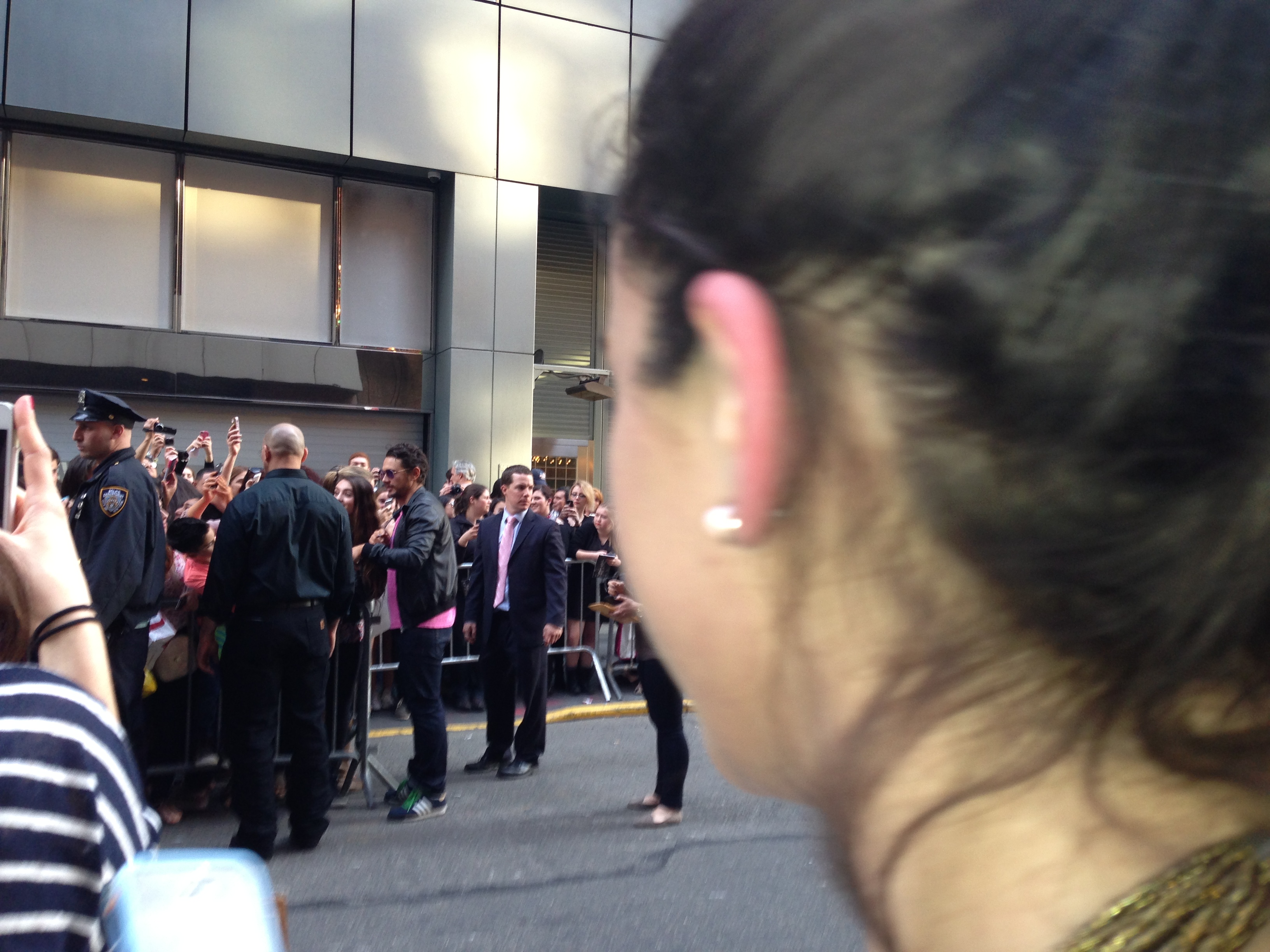
Afterward, my daughter and I join the large and expanding horde of Franco-worshippers at the stage door, most of them much less ironic than she is. We wait and wait and wait, Jeanne hoping for a selfie with him in the background, me hoping for a picture of Jeanne with him in the background. While we wait, O’Dowd comes out and works the horde, signing autographs and shaking hands. I can’t hear anything from my spot across the street, so I can’t say for sure whether anyone is thanking him for crushing their spirits.

An inquisitive Franco nudnik pipes up behind me.

NUDNIK: Who’s he?!
ME: It’s Chris O’Dowd.
NUDNIK: But who is he?
ME: Chris O’Dowd. He’s in the play. He’s fantastic.
NUDNIK: But, like, who is he?
ME: Chris O’Dowd. Irish guy.
NUDNIK: And he’s. . . who?
ME: Chris O’Dowd. He’s in “Of Mice and Men.” He was in “Bridesmaids”. . . ?
NUDNIK: But he’s, umm, who?
ME: Chris O’Dowd. Normally he’s funny. In “Of Mice and Men” he isn’t. But he’s terrific, just great.
NUDNIK: Who is he?
ME: Shut the HELL UP, Franco Nudnik! I hate you almost as much as I hate Steinbeck!

I don’t say that last part. But I kind of wish I had.

O’Dowd moves around the crowd and then heads down the street, away from us, so I don’t get a chance to thank him for making me miserable.

Bummer.

i guess i’m feeling a little bitter

the last damn hunk of ice in albany, new york is on my lawn

this had better be the end of it

My Dearest, Dearest Winter,

Now that you’re standing at the doorway with your bags in hand, saying your drawn-out goodbyes with that smug final glance over your shoulder, I just have to say it:

Good riddance.

I know, I’m being rude. But you and I have shared strong words before. And don’t you dare tell me your feelings are hurt, because I know better. You and your chilly, unsympathetic nature! You with your ice-coated sidewalks (do you not care who slips?) and skyrocketing heating bills! You shredded my wallet, man. Thanks to you, I stopped feeding my children so I could pay National Grid; are you aware they haven’t eaten since late October? NO? OK. Slight exaggeration. I actually fed them dinner tonight: perogies with sour cream and sauteed vegetables. But DO YOU CARE, Mr. Frosty the Snow “Man”? I think not. And yes, I just impugned your masculinity.

For the record, I am STILL a quote-unquote “four-season kind of gal,” and proud of it. I’m just not a quote-unquote “glutton for punishment”; a girl knows when she’s quote-unquote “had enough.” I don’t complain when it comes to normal winters, and I don’t care if I’m suggesting there’s something just a little bit abnormal about you. Because you, sir, are a freak.

A decent, self-respecting winter provides five things: opportunities to sled, skate and ski, especially with our brothers; a lovely white coating to hide unscooped lumps of dog shit dotting the streets; an excuse to sit inside and flab out while eating chocolate-covered pretzels and watching old episodes of “The Office”; a delightful, we’re-in-it-together grass-roots neighborliness and community building when snow falls and temperatures plummet; and a chance to feel morally superior to everyone who lives in warmer climes with lesser winters.

Of course, one cares not for moral superiority when one has lost all circulation in one’s toes and fingers. And I’ll tell you a secret about the permafrosty dog poop: Once winter ends, it’s all still there. Still sitting pretty (or whatever) as though nothing ever happened. The least you could do is take it with you when you leave. I’m sure there’s room in your suitcase.

What’s that you say? You say I’ll feel differently four months from now, when it’s 98 degrees out and 100 percent humidity and my eyelids are melting off my face? You say I’ll find myself yearning for your cool embrace, your chilly virility, your icy mien? That I’ll fling myself at you the way I always do, oohing and ahhing at your first soft draping over an earth that’s brown with autumn? That I’ll blush anew with my fondness for you?

Maybe I’ll love you again someday. But I’m done with you now, that’s for sure. So shut up. Get out of here. Hustle your XXXXL snow pants out of here, and don’t come back until you know how to treat a lady.

But wait — you dropped a mitten.

public speaking? scared? me? what? never!

So, in two days I’m going to stand up at the Egg in front of 1,000 people and tell an extremely personal story, and NO, MY FRIENDS, I AM NOT NERVOUS AT ALL. Nope. Not me. I tell personal stories all the time, right? And people read them, right? It’s all just bidness as usual for me. Ho-hum. La-de-dah. And, you know, it’s not like I’ll be unwinding some unfamiliar and overly convoluted and abstruse story that I’ll be trying desperately to remember, and why the hell am I using the word “abstruse”? Does anyone use it? Isn’t it an ugly thing? And you can just forget trying to say it aloud.

But, no. NO NO NO NO NO. I’m not nervous. I’m NOT! No cause for flop-sweats. I’m not in denial, either. And no, I’m not a liar liar pants on fire. Did I mention that I’m not nervous? I’m. Not. Nervous. Public speaking doesn’t scare me. I’ve public-spoken before. The first time I ever blabbed in front of a large-ish group was my first week in college, back when Hamilton required every poor quaking incoming freshperson to deliver a speech before a group of his or her freshpeers plus one terrifying-beyond-description public speaking professor, a ferociously bearded presence named Professor Wright who thundered his critique in stentorian tones and called everyone MR. THIS and MS. THAT.

Or did I hallucinate the beard? He wore one. I’m sure of it. If he didn’t, he should have.

I don’t remember what I said in my sad and feeble efforts at oration, but I do remember that I had bangs, which I almost always had, and that I spent much of my time studying the floor and declaiming to my feet, which I almost always did, and that Professor Wright scared the proverbial penne pasta out of me telling me not to. “Young woman! Young woman! You must LOOK UP and get that HAIR out of your EYES!”

Here’s what I’m going to do Saturday night at the Egg. I’m going to tell my extremely personal story in front of 1,000 people. I’m not going to crack up with fear, because I AM NOT NERVOUS AT ALL. And in memory of Professor Wright’s all-powerful voice and beard, which together spent 34 years terrifying undergraduates out of their worst rhetorical habits, I’m not going to stare at the floor.

And, hey. At least I don’t have bangs.