blows to the head

Parental love is a form of madness. If you have a kid, you know what I mean. If you don’t have a kid, imagine taking the most powerful love and joy you’ve ever felt, then adding the most powerful fear, than mixing in the most powerful sense of duty and responsibility, then chugging up the entire emotional mish-mash with the most powerful sense of drive and, when necessary, the most powerful, raging thrum of righteous indignation.

Most of the time, parents do a pretty good job of maintaining our day-to-day equilibrium without crumbling to pieces with worry over our children’s well-being. But when something happens to threaten that well-being, the madness kicks in: all the love, all the fear, all the duty, all the drive. And there is not a damn thing anyone can do about it.

Two Fridays ago, my son knocked his head on the ice while skiing. Thank God he was wearing a helmet. (Message to those of you who don’t: start the #$%!@ now.) The first aid peeps checked him over: a headache, but no other sign of concussion. That night: a headache, but no other sign of concussion. The next day: a headache, but no other sign of concussion. The next morning: a headache, but no other sign of concussion.

Then, during a pickup basketball game with his buddies, he took further knocks to the head. And the headache got worse. On Monday I took him to the doctor, and again: a headache, but no other sign of concussion. On Wednesday, when he complained of dizziness, I again took him to the doctor: this time, concussion. A mild one. And over the next few days, the headache abated — a little, but enough — until Saturday, when he slipped on the ice, landed on his arm and once again jarred his poor, bruised, aching, swollen noodle.

His headache flared up once more. On Monday it worsened. On Monday night, I noticed his eyes were red. On Tuesday I took him back to the doctor, who was concerned enough to order a CT scan. The radiation makes it a big deal for a kid; pediatricians don’t order them lightly. But before anything happened, the scan had to be “pre-authorized” by my insurance. This should happen quickly, I was told; the request went out with an “urgent” attached to it, I was told; the folks at imaging should contact me soon, probably within a few hours, I was told.

They didn’t. No one did. So I started phoning people directly, lots of people, people at the pediatrician’s office, the imaging department, the insurance company. Multiple people each place. No one anywhere had received any word of any such request. Thanks to protocol, it had to be routed through a specific person specifically designated in some specific pre-authorization office, but nobody I spoke to seemed to have any of these specifics. Kafka would have less trouble getting a CT scan.

To everyone I said essentially the same thing: My son has a head injury. He took successive blows. His symptoms have worsened. His doctor ordered a scan. It’s been deemed urgent. Urgent. It needs pre-authorization. This needs to happen now. Urgent. My son. We need to know if there’s bleeding on his brain. My son. Urgent. Now. Now. Did I say urgent? Did I say now? URGENT. NOW.

The words tumbled. The ire spiked. The tears flowed. None of it was acting. It all just overcame me, this ferocious maternal surge against the system. Hell hath no fury like a mother on hold.

Finally, I found someone in radiology, a kind and patient someone with a high tolerance for weeping mamas, who laid it all out for me: call the pediatrician’s office; get someone there to call insurance for pre-authorization; then have that same person call imaging with the required number.

Which I did. And they did. And to their credit, they were helpful and apologetic. And within an hour, my son’s head was being zapped by a CT scan, which I wasn’t happy about, because nothing involving a CT scan is ever really happy. But when they sent him home, I said a prayer of thanks and almost toppled from relief and spent adrenaline. Amen amen, my son’s throbbing little bean wasn’t leaking blood inside his skull.

On the drive home, I regarded this fine, brave boy of mine with wonder. He still hurt. Sunlight and sound still caused him pain. But I felt grateful: for him; for this good outcome; for a job that gave me flexibility to make all those phone calls, and for the bosses who understood; for my education and ability to speak my mind persuasively; and for my confidence, which gave me the gumption to advocate for my child.

But then I wondered about parents out there who don’t have those things — but still have a child who needs some treatment urgently. What if their son’s brain is bleeding? What if they can’t advocate for him? What if the red tape takes too long? What if they wait too long? What if he dies?

Madness.

i plunge, therefore I am

photo (25)

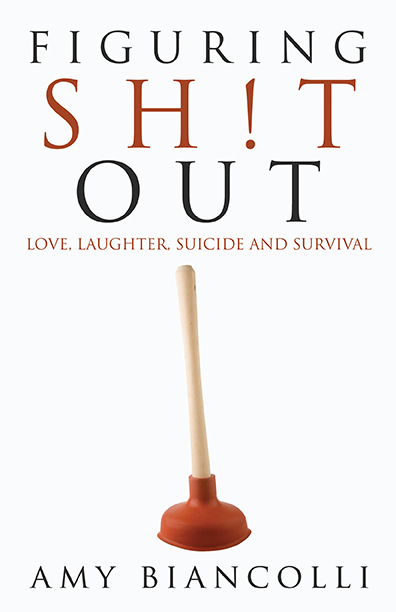
Proof positive that I found the right publisher for my nutcase little memoir coming out in September: this very gewgaw, a plunger from the island of Lilliput that arrived on my doorstep courtesy of Lynn, my editor at Behler Publications.

You’ll note a resemblance to the rubbery implement employed on the cover (and suggested by my daughter Madeleine):

sample 2B

Clearly, my book is in good hands. I don’t know what I love more, the wee tchotchke or the accompanying letter (“I saw this and thought of you!”), which suggests that I now remind people of shit and all devices related to its disposal. I’m the shit lady! Yes, I am! I wrote a whoooole book about the nature and disposition of poop, most of it figurative, emphasis on “most,” and then I started a blog about same. As a result, next time you see a plumber’s snake, your first thought might be that congested toilet you bravely unclogged with your bulging forearms at Thanksgiving, but your second will be me. Yup. Me.

And strangely, I am okay with this. No shit.

the philosophy of mac & cheese

macaroni
Mmmm. Mac ‘n cheese. I am not a great cook, but I’m an effective one: i.e., my kids think of me as a great cook, and they will continue in this blissful, innocent, semi-delusional state until they’re a little older and much wiser and have supped at the tables of many and better cooks than I. This is a final stage in growing up, this culinary awakening, and it tends to occur somewhere in the early- to mid-20s. My oldest just cracked that decade herself. So I have a few years to go, still.

Tonight, as I set this dish of baked nirvana before my 13-year-old, he was one happy fella. If only all human needs were met so directly, and simply, and effectively, and with the same gluey profusion of melted cheese. He scooped it, splooshed ketchup on it (yes, when it comes to eating mac and cheese, we are People of the Sploosh), devoured it, scooped out more, splooshed more ketchup on it and then abruptly stopped.

Analyzing the be-splooshed squiggles of elbow macaroni occupying his plate, he noticed a problem. Something was way out of whack with the mac-to-sploosh ratio. He took another scoop.

“I have to even out the balance of ketchup and mac and cheese by adding more mac and cheese, because there was too much ketchup,” he explained.

Ah. Wisdom for life. Finding balance in all things.

“It’s like, if you have too much dressing on your salad, you add more salad to even it out.”

That sounds deep, I told him. There’s some profound truth embedded in there somewhere.

“Yeah,” he said. “It’s like, the mac and cheese is the good stuff in life, the happy stuff, and the ketchup is the bad stuff that happens, the stress.”

He picked up the ketchup bottle and waved it in the air for emphasis.

“So if you have too much stress, you add more of the good stuff to even it out.”

And what’s the good stuff? I asked him.

“I dunno.”

Like, laughter?

He shrugged.

Time with friends?

“Maybe.”

Or maybe we’re forcing this just a little, I said. Maybe the mac and cheese with ketchup is just mac and cheese with ketchup.

“I think so,” he said, and our graduate-level seminar in the Philosophy of Baked Pasta and Condiments came to a swift end.

But I didn’t think we were that far off. The only fallacy in the mac-versus-ketchup thesis is the element of control. In eating, we can dole out the bad and the good, the splooshing and the scooping, without any interference from outside agents; in life, the giant generic bottle of evil splooshes whenever and wherever it damn well pleases. But that only makes the macaroni that much more important, our determined scoops of joy offering our only real counterbalance to the ketchup.

Or not. Probably I’m over-thinking this. Probably it’s just food.

I shut up and ate.

the mess of an answered prayer

Do you ever pray for clarity? Or maybe just scrunch your eyes and hope for it hard, if you’re more secularly inclined? I do. Quite a bit. Mainly because I’m almost always clodding along in some murk or other, my poor, pointy head piled with dust bunnies that fog my sight and clog my thinking. Wait, correct that. Put quotes around “thinking.” Because what I’m actually doing is “feeling.”

So I’m always asking the Almighty for some handy-dandy clarification on some matter or other. I sent up one such request a few weeks ago, and while I won’t go into the specifics, the gist of it was: HELLOOOO, LORD! WILL YOU PLEASE LET ME KNOW WHAT’S GOING ON, HERE?! I’M SORTA KINDA CONFUSED! THANKS AND LOVE, AMY!

The Lord replied in no uncertain terms, and in a manner I did not particularly enjoy, over the course of several days. The celestial public address system blared out loud and clear: HELLOOOOO, AMY! HERE IS THE ANSWER TO YOUR PRAYERS. IT MIGHT MAKE YOU FEEL LIKE A BIT OF AN ASSHOLIC AND CLUELESS BOOB FOR A BIT OF A WHILE, BUT DON’T WORRY, YOU’LL FEEL BETTER IN THE END! HAVE FUN! HOPE YOU ENJOY IT! LOVE, GOD!

And in the end, it helped. I did find my clarity. I came out the sunny other side of a long, winding, dark, malodorous, garbage-strewn tunnel, and if it seems to you I might be describing a voyage through an alimentary canal, you’re absolutely right. At its conclusion I felt as though I had taken a really big dump.

I felt lighter. I felt free. I wept with gratitude and thanked the Lord. I’m not kidding about that part. I did both those things.

The whole experience served to remind me that God — or the universe, if, again, that’s where your faith lies — isn’t exactly prissy when it comes to helping out. Prayer dissemination isn’t quick n’ smooth, like some lofty milkshake that’s made at our request. (HI, LORD, IT’S AMY AGAIN. COULD YOU PUT AN EXTRA SCOOP IN THAT? AND MAYBE A SQUIRT OF CHOCOLATE SYRUP? THANKS!) More often, it’s a right mess; and when the object is clarity, we’re really in for it. The answered prayer can be a hard-fought battle, littered with misunderstandings and emotional complications of the sort we like to avoid.

And in the middle of it, I generally send up another prayer, either a sarcastic THANKS FOR THAT or an inquisitive IS THIS SOME IDEA OF A JOKE? One of the things that most amazes is me is that God never reaches down and cuffs the back of my head with an irritated grunt. I suppose, being omnipotent and secure about it, the Almighty can take my snotty back-talk without resorting to whoop-ass.

Anyway, it all worked out. Clarity achieved! But as the old saw goes, be careful what you wish for. You might get it, it might take longer than expected, and you’ll probably need a flashlight before it’s over.

freaks and geeks and pierre and natasha

Lately my 13-year-old son and I have been bingeing on “Freaks and Geeks,” the brilliantly crafted, deeply human high-school comedy-drama — I HATE HATE HATE the word “dramedy” — that’s set in 1980 and ran one whole season on NBC in 1999-2000. Its 18 episodes stream on Netflix. We are, as I write this, 19 minutes shy from being finished.

He keeps wanting to watch those 19 minutes; I keep procrastinating. I don’t want the show to be over. Its characters are too real, its scenarios too familiar, its emotions too nuanced and thorny and true. Some of its cast members became big deals on the big screen — James Franco as a sweet, dimwitted burnout, Seth Rogen as a joker with a heart of mush, Jason Segel as a scary-obsessive romantic — but the work they did on this show is as fine and affecting as anything they’ve done since. And the rest of the cast is just as memorable: Samm Levine, as a nerd in a sweater vest, looks, talks, cracks wise and comports himself like a minikin 40-year-old Borscht Belt comic. I love that kid. I love ’em all.

I’m sad just thinking about it. And I’m reminded of the gloom that began to set in as I approached the last 200 pages or so the first time I read “War and Peace” back in, jeez, what was it? The late 1990s? My late husband had been pressing me to read it from just about the day we met in 1990: “It’s like walking into a room,” he’d say, and I remember thinking, “What? A room? What kind of room? Isn’t it filled with ornately decorated tsarist furniture? And aren’t they all speaking Russian and have painfully long names?”

Actually, they’re all speaking French and have painfully long names. Don’t worry, I’m not going to regale you with them all, or the plot, or a detailed re-hashing of the Battle of Borodino, or even the moment when a plastered central character almost teeters out a window to his death — although I’m tempted. I am, however, going to point you to my friend Donna Liquori McGuire’s spot-on mash note to Tolstoy’s masterwork that ran recently in the TU and describes perfectly the hypnotic spell cast by that dense book, its breathtaking scope, minutely realized characters and gorgeous flushes of authentic, timeless emotion.

Once you get into it, you want it to go on forever. And at 1,250 pages, it does, in fact, go on forever. But those last 200! You don’t want them to end! I wanted Pierre, dear, awkward, decent Pierre, to fumble his way around Russia. I wanted ebullient Natasha to spark with sudden love. I wanted Nikolai to dally with hearts, and go off to war, and be a boy trying hard to be a man.

This is what I love about stories: When they work, they live. The characters quicken and stir. They walk around, they breathe within us, they speak. Finishing a great story, be it a thick Russian novel or a short-lived retro TV series, feels like saying goodbye. A kind of grief sets in. Those people and those places, once so real and alive, have settled into a hibernation — not quite a death — and can only be roused when someone new comes along and prods them all awake.

You can re-read and re-watch, but the second time feels less real than the first. We know what’s coming down the pike, for everyone. They’re all a little less there.

So, no. I don’t ever wanna watch the last 19 minutes of “Freaks and Geeks.” But my son is waiting downstairs for me — and off I go.

‘the moth’ and the egg

Well, this is exciting news here in the realm of Figuring Shit Out. I’m going to be on The Moth! Inside The Egg! Yep. The Moth, for those who don’t know, is a podcast and radio hour devoted to storytelling. The Egg, for those who don’t know, is a wackily-shaped performance venue at Albany’s Empire State Plaza. Whether it actually looks like an egg is open to debate. You can argue about it here, if you like. You can also listen to They Might Be Giants’ marvy song inspired by and devoted to it. See below.

“Lost and Found: The Moth in Albany” will take place at 8 p.m. Saturday, March 22, which I’m just now recognizing as William Shatner’s birthday, and wow, that’s an omen of some kind, right? That must mean something powerfully important, although I can’t imagine what, maybe some harmonic convergence involving orbs of influence and Jupiter in Aries or Uranus whatnot, but only if we all promise to pronounce “Uranus” as “UrANUS.” Or else it means I had such a brain-eating nerdalicious crush on him in 1976 that I memorized his birthday. You think? Is that it? That must be it.

Anyway, so I’ll be telling a story from my forthcoming book, “Figuring Shit Out: Love, Laughter, Suicide and Survival,” which concerns my husband’s suicide and aftermath and is due this fall from Behler Publications.

No word yet on ticket prices and suchlike, but I’ll post an update when I have more info, I promise.

Meanwhile, lend your ear to some “They Might Be Giants” tasty tunefulness. “Permission to land The Egg / Where should I stand? / The Egg, The Egg / No corners for youuuuuuuuu.”

luigi

jeanne and louis, early 60s

There they are: my late parents, lovely Jeanne and handsome Louis. He was 16 years her senior, 56 when I was born in 1963. Nowadays, not such a strange thing, to see an older parent at a school concert or a playground. Back then, it was peculiar enough that the news of my birth was met with amused relief by his assorted man-friends. “Hey, Lou!” they said, or so my mother reported to me many years later. “Good thing it’s a girl! Otherwise, you’d be out there throwing around a baseball in your 60s! Har har har!!”

To which I say: Har. Har. Har. Guess WHAT, knuckle-dragging sexists of the Neolithic? My father was out there throwing around a baseball in his 60s ANYWAY! In fact, he did that into his 70s! So there! Bronx cheer! Pppplllllllll!

But they didn’t know any better, really. Times were different. Sex roles were different. Fathers were different.

My father — Daddy, I called him — was a classical music critic and an author, co-author, editor or co-editor of a baker’s dozen of books. He was brilliant. He studied, read and spoke 16 languages, several fluently.

The eldest son of Italian immigrants, he embraced learning early on as a path to enlightenment and never abandoned it. He worshiped Beethoven, my mother and Thomas Hardy. He wore a beret morning, noon and night. He ate crystal blue mints and prunes, although not together. As a young man in Little Italy he sparred with his pal Big Lou Barba, but then Barba went punch-drunk and Daddy swore off prizefighting and violence forever. The only thing I ever saw him hit was a small bag at the back of our L-shaped porch in Connecticut, and when he did, our house rattled like the wrath of God.

He was a charismatic man. A sweet man. A terrible, terrible punster. (“I’m going for the mail.” Pause. “But not the female.” And he’d say this every single time he went to the mailbox.) He was a surprising man, too, offering to yield his patronymic to the matronymic because he thought “Mitchell” might be an easier name for his daughters to bear through life than “Biancolli.”

He was charming man; he once talked a mugger out of stealing his wallet (“Do you really want to? My late mother gave me that!”). He was a brave man; on the subway, he stopped a knife fight by laying his hands on the young men’s shoulders and saying, “brothers, brothers.”

He played the piano and the accordion by ear. His favorite song was “Melancholy Baby,” and he loved to belt it out in English and Neapolitan, his first language. He sang it for everyone who’d listen, including the friends and strangers he encountered on his walks around Lake Waramaug — walks he took every day, well into his 80s, long after his memory up and left him and everyone became a stranger, everyone became a friend. And as he walked, he swirled his arms, pumping out his Swedish calisthenics to a silent beat.

When he died, at the age of 85 in 1992, I imagined him as a young man — the young man I never met, strapping and sharp. I never knew that father. I never tossed a ball with that one. Sometimes, as a kid, I wondered what it might be like to have a conventional dad, one who still worked, who hadn’t struggled with depression and dementia, who wasn’t so often mistaken for my grampa.

But the one I had did his best. The one I had loved me, knew me, thought the world of me. The one I had smiled when I asked, “Daddy, can we play catch?” Even better, he said yes.

dark matter rocks

I love dark energy. Love it. Dark matter, too. I have no idea what they are, but it’d be weird if I did, because no one does, not even all those crazy-smart astrophysicists who hypothesize their existence. All anyone knows is, dark energy in all likelihood accounts for about 68 percent of the universe (68 percent! that’s a passing grade in some places!), and dark matter takes up 27 percent, leaving plain ol’ ordinary matter, the mundane, run-of-the-mill, observable, occasionally stinky crap, to take up a mere 5 percent. I won’t even venture a guess on how much of that 5 percent is found in McDonald’s value meals. A lot.

I’ve been Catholic for 24 years. Been a Christian for 30 or so. Believed in God for almost 40. Before that, following the lead of my atheistic father and agnostic mother, I believed only in the goodness of humanity and the largeness of creation. But I tell you what: those beliefs remain the essence of my faith. As frustrated as I am by my failure to see the future, as sidelined as I am by my tendency to fret, I’m relieved to know that I don’t actually know a thing. It’s a gift to realize the full scope of what I can’t see with my squinty eyes and hear with my whistling ears and grasp with my pointy head: at least 95 percent of all existence. That’s a shitload of stuff I won’t ever understand. Thank God! There’s more to life than value meals!

We can all agree on this point, right? Whether we believe in a deity or dark matter?

Me, I’m down with both. I don’t believe that science and faith are incompatible. Faith, to me, is not an obeisance to the known but an acknowledgment of the unknown, an abandonment to it, an against-all-odds conviction that a limitless Unseen lurks and envelops us. In describing the universe and its mysteries, scientists delve into that Unseen and assign it properties, laws, shape.

I assign it character, too. I assign it love. I can’t see it, but I’m sure it’s there.

why we moon

When my sister Lucy and I were little, around 6 and 3 or thereabouts, we used to moon people. I have no idea where the inspiration for this came from, but we got it from somewhere (this was, after all, the late 1960s), and we exercised this vaguely inspired right to moon on our front lawn in New Preston, Conn., for all the world to see. Or maybe not all the world; maybe just passing cars.

At the time I never wondered what the drivers and passengers of these vehicles might have thought, tooling around Lake Waramaug on their leisurely summer drives, approaching this fairly standard-looking white colonial with its fairly standard-looking lawn. Or it might have been standard-looking, had my parents mowed the bottom half of it — they kept the grass high to prevent their darling children from rolling their tricycles into the road, so it looked perpetually unshaved, like Yasser Arafat, Josh Groban or a goat — and had these same parents prevented these same darling children from bending over and dropping trou for unsuspecting tourists.

But they didn’t know, and they didn’t prevent us, and so we had our fun. It consisted of this:

(Inside)
Lucy: Let’s go outside!
Me: Okay!

(Outside)
Lucy: Let’s wait for cars!
Me: Okay!

(A car rounds the bend)
Lucy: Let’s drop our pants and shake our butts!
Me: Okay!

(Dropping our pants and shaking our butts)
Lucy: Ha ha ha ha ha!
Me: Ha ha ha ha ha!

Sometimes, for even more fun, we would perform this dropping of the pants and shaking of the butts while chanting DAY, D-D-DAY, D-D-DAY, and don’t ask why because I don’t remember.

At this point, cough cough, I would like to assure people that I have not mooned anyone since, neither in Connecticut nor Albany nor anywhere else I’ve lived, on any other lawn, be it standard- or non-standard-looking, mowed or unmowed. I do wonder, however, whether my urge to write memoirs and blog about personal matters — such as, for instance, my childhood de-pantsing habits — themselves classify as a sort of mooning, a way of saying, LOOKIE HERE, PEOPLE! I HAVE ALL SORTS OF HIGHLY PERSONAL BID-NESS TO SHOW YOU!! I DARE YOU TO LOOK!

So, really, I can roll my eyes all I want at instances of dumbass celebrity mooning (Justin Bieber instagrammed his lustrous pop-god tushy just a few days ago), but I’m not sure that what I’m doing is all that different. To moon is to show your hidden self to the world — to seek attention, tempt rejection, find acceptance, and maybe engage in a little defensive mockery, just in case. Because you never know, until you stick it out and shake it, how your rear will be received.

Day, D-D-Day, D-D-Day.

accidental beauties

sunset

If you live in Albany, did you catch the sky at sunset tonight? It was all cotton candy magnificence. I saw it by accident through the upstairs bathroom window, and it caught me at just the right moment: I’d been fretting about something over which I have no control, which is, of course, the nature and boundless asininity of fretting. One never frets over the distressingly few things over which one has control, such as whether or not to floss before bedtime. (“Aggghhhh! I wish I knew! The suspense is killing me! Crap crap crap!”) Instead one frets over the infinite number of things outside our own personal agency. If we have no authority or power to act — and if we forget, for some long moment, that surrender is our only real and rational option — we brood.

I was brooding earlier tonight. But then I glimpsed the sunset, and the cloud of fuss suddenly lifted, whiffed away by those ribbons of pink and blue.

A similar lightening of spirit had occurred over the weekend, as I tooled through light whorls of snow along the Petersburg Pass to Williamstown. Once again, I was stewing. Once again, it concerned a matter over which I have no control. But then, mid-fret, I came around that glorious, mountainous, rising curve that swings into the Berkshires with an abruptness that always shocks me; I’ve driven that road a thousand times, and still, that morning, it caught me unawares. And I stopped fretting. Not only that: I felt like a boob for having fretted at all. Why should I chafe over little nothings, when the world can throw such beauties in my midst? They rise out of nowhere with the force and largeness of truth.

That’s what matters. Not that niggling, nagging stuff. And when the awful shit lands, the real shit, worrying won’t fix that, either.

Sometimes, flipping through the bible at night, my thumb lands on a passage from Matthew that addresses the boobishness of worry: “Can any one of you by worrying add a single hour to your life?” Ummm, no. Definitely not. That there is one apt rhetorical question, Jesus. And yet I do it. I worry. I did it again in the bathroom tonight, right there at the sink, just by the floss — which actually might add an hour to my life. But then I looked over and saw the sky, and I opened the window, and I snapped a picture, and I smiled. No more fretting. For now.