princess schroeder golightly

leia

Like many other people, I took the “Star Wars” personality test floating around Facebook recently. And lo, it appears that I’m Princess Leia.

I find this result beautifully affirming (I am bold and unwavering! I have a sharp, diplomatic mind!) when I’m not grabbing my ears to reach for the baked goods (I have sticky buns attached to my head!). Who doesn’t want to be told she’s the heroine of an archetypal if badly written space saga?

Then I recalled that I had also taken the Peanuts personality test and learned that I’m Schroeder: artsy and aloof. This plunged me into a flurry of self-doubt — good God! Am I coldly analytical and standoffish, hunched over a piano in a quest for perfection?! — until I remembered I don’t actually play the piano.

And then I recalled that I had also taken Book Week Scotland’s personality quiz, which, ta da!, informed me that I am, in fact, Holly Golightly from “Breakfast at Tiffany’s.” No shit. Finally! Affirmation from the wise forces of Facebook that I am bubbly, gamine, party-animalistic and a just little bit tragic, especially when you take into account my long and pathetic string of sugar daddies. I’m not sure who they are, or where I’ve hidden them all these years, and whether they’re still interested in me now that I’m 50.

But what I really want to know is: Wouldn’t Princess Leia kick Holly’s ass? And Schroeder’s? I think so. Both of them at once, while simultaneously whipping all the men in the galaxy, and most of the ewoks, into shape. She didn’t need a sugar daddy. Okay, so she wanted Han pretty badly, and he was sort of a jerk about it, but you always knew she could and would kick his ass, too.

In other news, the Myers-Briggs test says I’m an ENFJ (extraversion, intuition, feeling, judgment). Some other test I can’t remember told me I’m an “ambivert,” i.e., some hybrid creature between an introvert and an extrovert, but to me that sounds like a sexual preference or an abstruse geometric concept rather than a personality type.

If Princess Leia took that test, she’d be slotted as an extrovert. So would Holly. As for Schroeder, he’d be an introvert. He’d never stoop so low to take the “Star Wars” test, but if he did, he’d be Obi-Wan; if he took the literary quiz, he’d be Sherlock Holmes (or, if he’s in a dour mood, Raskolnikov); if Princess Leia took the book quiz, she’d be Jane Eyre; if she took the Peanuts test, she’d be Lucy; if Holly took the Peanuts test, she’d be Sally; if she took the “Star Wars” test, she’d be Luke. And Leia would still kick her ass.

on foresight and flying: a rant

I HATE not knowing things. Hate it. Hatehatehatehate. And yet I know I can’t know more than I already know, or I’d lose my mind, and I know that can’t happen, because I gotta hang on to that thing no matter what.

This is what I can’t stand about not knowing: NOT KNOWING. “More will be revealed,” say folks in A.A., but to me this aphorism begs the question: about what, exactly? YOU WANT TO GET SPECIFIC, PEOPLE? I find myself repeating the line myself, over and over and over, barking out a truism designed to drive everyone nuts. And yet, on hearing it, we all cross our arms and nod not-knowingly, saying, AHHHH, YESSSSS, THAT’S SO WIZZZZZZE. And it is indeed WIZZZZZZZE. I am so so super-glad I never knew most of the shit that’s happened to me before it happened, especially the really bad shit; and the worse the shit, the more relieved I’ve been about not-knowing it.

That said, I’ve always been impatient. I’ve always wanted to grab exclusive sneak-peaks into the future, especially any future involving exam results, Christmas gift contents and cute boys. Although, if I had my pick of godly Marvel superpowers, I’d probably choose flying over foresight. It’s what I do when I find myself in a dream: I realize, Hey! Yay! Excellent! I’m not awake, so I can fly! and then I just flip open a window and bomb around the sky in my pajamas. Flying PLUS foresight would be really cool, because then I’d know exactly which direction to head in for the most exciting Christmas gifts and cutest boys. Whenever I have another lucid dream, I’ll have to give that a whirl.

This not knowing: It makes me feel like a kid again, a dizzy one wearing a blindfold whose purported caring friends and purported loving parents have spun her around and around and around and then pointed her in the wrong direction, saying, “Go ahead and pin the tail! Ha ha ha! There’s the donkey! Ha ha ha!” knowing damn well the poor wee thing will never find the donkey in that state. Ignorance is such an essential part of the human condition that we make a game out of it at our children’s birthday parties. At least we used to in the 70s. But we were so much more sadistic then.

So I’m in the dark. You’re in the dark. Everyone’s in the dark. We wander around in the pitch black, blind as bats without the aid of echolocation, following each other’s voices, bumping into each other’s butts, chasing after pin-pricks of light in the distance. And somehow we get from point A to point B and point B to point C, although we have no idea how far up the alphabet we’re supposed to progress. And which alphabet? What if I’ve been using the wrong one? What if it’s, like, cyrillic?

I guess that’s why they call it faith. I guess that’s why we’re here. So I guess I’ll just have to keep groping blindly along, crashing into whatever butts I meet en route to wherever I’m going. A girl can hope.

a fresh layer of joy

photo (21)

the awesome wedding cake topper (designed by the awesome bride)

Last night, on what would have been Chris’s 58th birthday, our youngest nephew married his sweetheart. They made their promises, swapped their rings, danced to a Randy Newman song under swirling disco lights, laughed and kissed and beamed before a ballroom full of people awed by love.

A fresh blanket of joy now lies across a date so thickly layered with gratitude and grief. I thank heaven Chris was born. I wish to that same heaven he hadn’t died. It’s that simple. That complicated. But a new thickness now overlays the older, crustier strata, and it’s softer than the others. It warms me. Watching my nephew and his new wife work the room, flushed from love and dancing, reminded me — all of us, at this and every wedding — that yes, life surprises and prevails, and no, we’re not delusional to believe in it. We’re only human.

Or would you prefer a more edible metaphor? Layers of creamy wedding goodness, a sweet fluff of bliss to top them all? Oh, why not. I’ll bite. Pass the cake.

let’s talk about mental illness, really

Happy Lou, long after the storm.

Happy Lou, long after the storm.

On the horn with Madeleine recently, she asked me: “Mom, did you read Nicholas Kristof?” This is a question that she often asks and always makes me happy. That my 20-year-old daughter reads The New York Times and keeps such close tabs on her favorite columnists warms the cockles of my newswoman’s heart, whatever the heck cockles are. (And are they normally that cold?)

Turned out Kristof’s column a couple Sundays back raised an issue that cuts close to home for us. He called on the news media to stop neglecting mental illness — to address it honestly, compassionately and comprehensively, looking at real people who struggle with depression or eating disorders or suicidality or P.T.S.D., rather than weighing in with generalizations after the latest mass shooting. “All across America and the world, families struggle with these issues,” he wrote, “but people are more likely to cry quietly in bed than speak out.”

No one likes to talk about mental illness. The thought alone unsettles, embarrasses, terrifies. After my father attempted suicide with sleeping pills in 1974, he spent nine days in a coma and six months undergoing pure talk therapy at the Institute of Living in Hartford, Conn. — which worked — and I spent those same six months not answering the unspoken questions of everyone at school. One kid who dared mention my daddy’s stay in a psych hospital got promptly shushed by a teacher. And I remember thinking, more or less, “What the fuh?” The message was clear: This type of illness, with this type of hospital stay, is not to be discussed.

Bullshit. We need to talk about it. It hits people.

My father recovered from his depression and went on to live another 18 years — no psych meds, no recurrence, though the coma probably hastened his dementia. My sister and husband weren’t as lucky. I’ve now written about all three of them (two in my last memoir, one in my next one), so I’ve obviously overcome any lingering reluctance to discuss suicide in a public forum.

It’s all out there; I’m all in. I don’t have much choice in the matter. Because, face it, if I decided I couldn’t talk about the people in my life who’ve been affected by mental illness, I WOULD HAVE VERY FEW THINGS TO TALK ABOUT.

As a people, 21st-century Americans are open to discussing so many things: our sex lives, our hoarding, our fights against life-threatening ailments. But when we try to discuss this brand of fight and this brand of ailment, our jaws lock. We can’t go there — not because it’s all too alien. Because it’s all too familiar. Because too many of us have cried quietly in bed ourselves, or have heard a loved one’s weeping.

There’s no cause for shame in mental illness, no cause to feel isolated. We only think we’re alone because we’re so tight-lipped, so scared. Every time I’ve lost a beloved someone to suicide, people have emerged from the shadows to confess that they had, too.

How can we combat this scourge if we don’t face the darkness squarely? How better to nurture and bulwark our own peace of mind than to name the insanity, call it out, give it form, understand it, find its weakness, see its depths? How better to stay sane and alive ourselves — which are, in the end, one and the same thing?

So let’s talk about it. Really. And let’s start now.

hello, and swasti astu

Here I am, in the trashbag aisle of the supermarket, when a 60ish guy with a muss of a beard brushes past and mutters it. “How ya doin’.”

I glance over. His left arm is clutching tupperware to his chest like a baby. Hanging from his left arm, a six-pack of coke.

He isn’t even looking at me, so I don’t respond. That would be senseless. That’s not part of his plan. He seriously doesn’t give a shit how I’m doin’.

I push my cart to the dairy case, toss in generic Greek yogurt and half-and-half. Then I push it into a checkout line and pull up to a woman with six-inch hoops hanging from her face. I’m temporarily mesmerized by them, wondering why on earth I don’t wear earrings that big, when she mutters it, too.

“How ya doin’.”

She isn’t looking at me, either. She gives about as much of a shit as the guy in the Hefty aisle. But I do my part.

Fine, I say. How ya doin’.

She still isn’t looking, but she does her part, too.

“Fine.”

Well. Phew. Good thing we took care of this hollow but somehow gravely significant ort of social etiquette. But on the walk through the lot back to my car, rolling my yogurts along the tarmac, I wonder why we do it. And I wonder whether it wouldn’t be nice to do away with “How ya doin’s” — and all of its variations, from “How are you” to “What’s shakin'” — unless we actually mean it. Unless we actually want to hear a true response.

It wouldn’t be easy, given the habit-forming business of having mouthed “how are you” about 13 katroollion times since birth, or at any rate since we all started dumbly parroting everything we heard. It also wouldn’t be easy to process the answers we might get: “Thanks, my hemorrhoids flared up this morning, but they’re a little better now” or “Glad you asked! Last night I sucked face with the handsomest guy!” or “Actually, I was just bawling my eyes out in the bathroom; are my cheeks stained?”

Because, seriously, what if we’re not all fine? What if our worlds just came crashing down around our heads in little painful shards? I was discussing this with someone whose world had, in fact, recently imploded, and I was apologizing for the dumbassedly reflexive way I had opened our conversation with “how are you?” Is there anything more trivializing?

So I propose we come up with some viable alternative. I’ve tried “What’s going on?,” but that one feels brassy and belligerent. (Like, what do you think I’ve got goin’ on, man? And you got a problem with it?) “What’s up?” is too cutesy. “What’s happening!” is too late-1970s sitcom with canned yuks and bell bottoms. “How goes it” is a bit too brusque, and not much of an improvement over “how are you.” As for the previously noted “What’s shakin’,” the last time I deployed it on someone, the person looked at me as though I had just opened my mouth and spat out a giraffe.

My father Louis, a passionate amateur linguist, had a phrase he often used when he bumped into people on his daily constitutionals: “Swasti astu.” It means “bless you” or “peace be with you” in Balinese, and I think it’s dandy. I might start using it myself.

Anyone have any better ideas?

this too shall pass

This weekend, I got a stomach bug. I will not go into any great detail, as I prefer not to offend the tender sensibilities of those I offended with last week’s horrifying mold photo, and if you suspect I’m going to find endless (and endlessly lame) excuses to link to it from future posts, you are correct.

But the stomach bug. Not the worst I ever got, but bad enough. What struck me, early on, was that old familiar sense of abandoning myself to the fates — that what-the-hell, here-we-go, whoop-dee-do resignation as I accepted the fact that I’d be flat-out miserable for the next 8 to 24 hours. And I was. Again: no great detail.

But here’s the kicker: I knew that I wouldn’t be miserable forever. I regarded this stroke of bad luck as finite, and in a flash, I recognized spasmodic abominable gastrointestinal distress as the perfect metaphor for life’s periodic grips of pain. They sneak up and slam us flat and maybe render us useless (or weak and dehydrated and headachy, with that awful, scraping burn at the back of the throat), but we know from that first stab in the gut that they won’t last forever. Maybe they’ll ease off, dupe us into thinking they’ve left, and then come back a few hours later with a fresh dump of agony. But then that’s over, too, and we awake in the morning with a clear head and an irrational swell of optimism. Life is good, right? Fantastic. Primo. Except when it ain’t.

Everything’s finite. Everything cycles in and out. Good and bad, clean health and illness, joys and sorrows: they all come and go, obeying some unfathomable but relentless clock that won’t let us live with anything for long, whether it’s a welcome anything or an unwelcome anything. Stomach bugs seize us and leave (sometimes at our children’s athletic events, no great detail), but so do bouts of wonder. So often we’re clenched by blessings — embraced by a child, caressed by a lover — in moments that feel eternal but end all too soon.

This weekend’s virus didn’t quite feel eternal, although certain moments in certain places hold a certain accursed fixedness in my imagination, and here’s where I really want to explain to that woman in the UAlbany restroom Saturday morning that I really wasn’t drunk. No great detail. But even in the most abysmal throes, I kept reminding myself that I’d feel better eventually, whether “eventually” meant later that day or, as it turned out, Annie’s bottom-dollar-betting tomorrow.

I’m sure I’ll get hit with another stomach bug someday. And when I do, I’m sure it will involve 8 to 24 hours of flat-out misery. But right now, typing these words, all is well. My kids are happy and accounted for; my bills are paid; my house is warm; my stomach is at peace, even downright euphoric with relief, and so am I. It’s just a moment. It will pass. But for now it’s a gift, and I’ll take it.

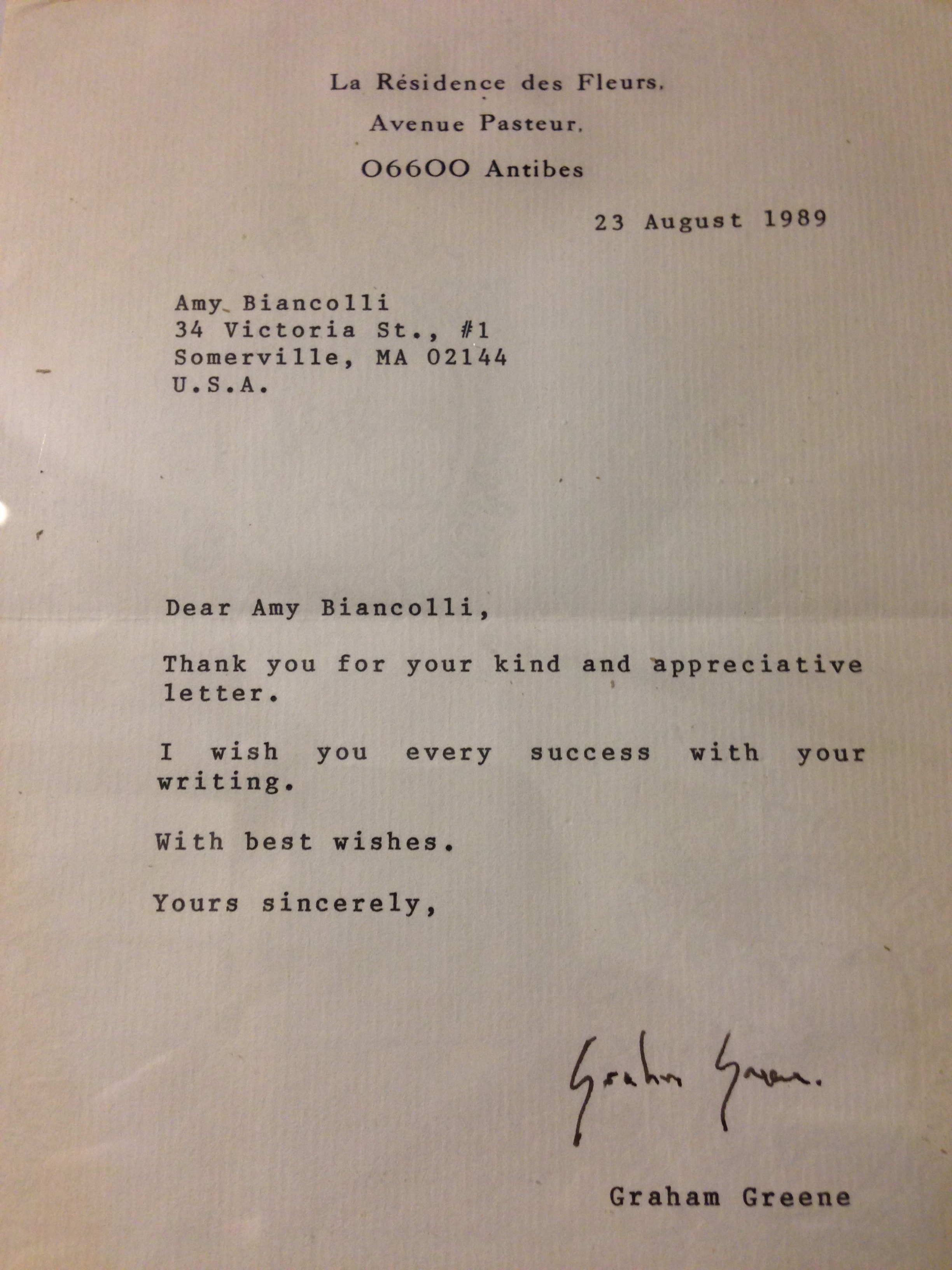
my missive from graham greene

photo (19)

Shatner never wrote back. The poop.

In the summer of ’89, I was living in Somerville, Mass., that unfairly maligned suburb of Boston. For three years, my sister Lucy and I shared the bottom third of a triple-decker house with a third roommate, and if I were numerologically inclined, I might extrapolate some woozy mystical import from all those threes. Hmm. Weird. But I’m not big on numbers. Words are my bag, and have been since I decided at a stupidly young age that I wanted to be a writer when I grew up.

I had no idea what this meant. I knew that my dad, Louis, was a writer, because I’d seen his name on the spine of quite a few books lining our shelves, and because he periodically retreated behind closed doors and made violent pounding noises interrupted by dings. He brutalized typewriters. I do more or less the same with computer keyboards, or so I’m told by colleagues too often forced to pick the shrapnel from their sad and bloodied faces.

In fifth grade, I think it was, I volunteered to help write the script for some school play or other, and I remember nothing about the process other than it yielded utter crap. A year or two later, a venturesome English teacher broke her class into small groups for a similar exercise in playwriting, and once again, I found myself writing utter crap. But at least I remember it; memorable crap always preferable to the bland, nameless and neglected sort that squats in the cobwebs of some dingy corner of the brain.

No, this second attempt at writerly writing was well worth remembering: It was a soap opera. The story began with my character spouting some drippy dialogue before heading offstage to get hit by a car, only to return in a wheelchair — that is, a molded plastic school chair pushed by a classmate. I even bent my legs underneath me to simulate amputation. I’m not shitting you. It was that bad.

From this propitious beginning, my writing career progressed to the woolly English essays and groovy abstract poetry I wrote in my teens. Around then I decided on journalism, and thank God I did, or I might still be writing blank-verse meditations on life and swirling blobs of color. In college I discovered William Faulkner and Flannery O’Connor and Graham Greene, whose dark/light depictions of God, Catholicism and our combative human nature spoke to my own noirish inclinations and budding spiritual life.

In my mid-20s I was living with Lucy — watching her light spirit fight against the dark of suicidality — and gobbling up the last of Greene’s gripping, unsentimental novels, with their screwed-up protagonists and grayscale overlaps of good and evil. I’d read somewhere that he lived in Antibes, and that he responded to every letter he received. These two pieces of information emboldened me to fire one off. Into one page I crammed my appreciation for all that he gave me, all that I learned, all that I hoped for with my own young ambitions.

I addressed it “Graham Greene, Antibes, France,” and it got there. He wrote back. Finding that envelop in the mailbox outside my apartment remains one of the great postal triumphs of my life, ranking between my acceptance to Hamilton College (which had both a great English department AND a freshly minted women’s varsity soccer team, thank you, Title IX) and that autographed glossy from Gene Kelly (the hottest man ever to dance in high waters). He responded to my fan letter, too. William Shatner didn’t. But I don’t hold that against him. Much.

I cherish my missive from Graham Greene. Whether it pushed and punted me down the road to being a better writer, I don’t know. But over the years I’ve turned to it at moments high and low, focusing intensely on that one line: “I wish you every success with your writing.” Every success. Not just worldly. Not just money in the bank and eyeballs on the page. He also meant creative success, the quiet victory of simply putting a decent sentence together — and then two decent sentences, and then a few decent paragraphs, and then an article, a play, a book.

Because it isn’t so simple; it isn’t so small. The threat of utter crap looms always and everywhere, held at bay by the thrashing of keyboards. And somehow, I still want to be a writer when I grow up.


beautiful-mamaHere I present one of the most beautiful images I own: an early, glorious, glamour shot of my late mother, Jeanne Frances Mitchell Biancolli. Mama for short.

I could write a book about this woman. Maybe someday I will; I already devoted a sizable wedge of paper to her in my last wild stab at memoirizing, “House of Holy Fools.” I also wrote about her, and my second mother, Pat, in a Times Union column last summer

As you can see, she was a knockout. What you can’t see is the blueness of her eyes, the outrageousness of her wit, the flintiness of her spirit, the wiriness of her arms or the roughness of her left hand’s fingertips, which were calloused from many hard hours of practicing the violin. Those callouses said it all for me. They said: Beauty makes demands on us. It hurts. It toughens us, but in a good way, a necessary way. Sometimes, in the creation of music and the living of life, we grow new layers of skin.

Mama was a world-class concert violinist who performed six times in Carnegie Hall, toured South America and Scandinavia, soloed with the Philly under Ormandy — while drawing raves for her musicianship and wolf whistles for her looks. My father Louis, a music critic for the New York World-Telegram, reviewed her and loved her playing long before he loved her, too.

When she played, all that she was came out in her violin: Her music was an aural blast of authenticity, clarity, intellect, deep human insight and ferocious emotional might. She always said exactly what she knew to be true, in words and music; her phrasing was apt and efficient, whether nailing rubato in a hunk of Brahms or flattening me with straight talk when I was mooning over a boy. (“He’s pretty, I take it.” Quarter-beat rest. “Just be sure you’re not thinking with your gonads.”)

This directness drove me nuts, sometimes. When I was a teenager, more than sometimes. I now recognize it as Mama’s single greatest beauty, a source of strength and balance in a house so often cluttered and listing. But not when she played the violin, or my sister the piano. Not when we laughed. Not when she cut through all of it with her piercing, uncompromising, fearless mind. That was as clear as her eyes, as sinewy as her arms, as powerful as her music.

don’t you take that tone with me

photo (18)

Yum.

So over the weekend I was cleaning out my fridge — BEFORE it started to smell like a landfill — and found, way, way, way at the back, hiding out like a poor, lost, fuzzy child, or maybe a fugitive from justice who’s been on the lam from Albany County Sheriff deputies for 87 years, the above advanced mold formation.

And when I say “advanced,” I mean it probably talks. In all likelihood it holds a Ph.D in some obscure academic discipline, like the history of peanut farming or Indoeuropean ethnohistoriographic geomorphology. If I asked it how long it had been in the fridge, it would respond, “Umm, twelve weeks, maybe?” and then add, “No, no, more like six months, it was before I grew the beard” before snapping, “Why the hell do YOU care, anyway? It’s kind of late to ask!” I would then turn defensive, saying I’ve only owned this particular fridge since late November, so Professor Snotty Fungus couldn’t be more than six weeks old, seven tops, at which point the mold would roll its eyes and say, “Whatever.”

At first, after liberating this sentient being from the back of my fridge, I wondered what form it had taken in its larval stage — i.e., when it might have been defined as “food.” I tried staring at it really close, but not too close, 1) because I’m far-sighted, and as I bent over my reading glasses slid down my nose into the fuzzy part, which, by the way, was wet; and 2) because it kind of scared me.

Then I recognized it. Do you? If you don’t, I don’t blame you; it looks more like Rip Van Winkle’s deformed lost twin, the one that got half-absorbed into the placenta before being born, than something that might in an earlier era have been consumed by anything other the occupant of John Hurt’s chest in “Alien.” Speaking of aliens, it rather resembles those flying neural boogers that sting Spock in the back in that old episode of “Star Trek,” doesn’t it?

Otherwise, I’m not going to say what it is. If you’re not too grossed out to give it a close look, you can guess.

launching exclamation points . . . now!

sample 2B
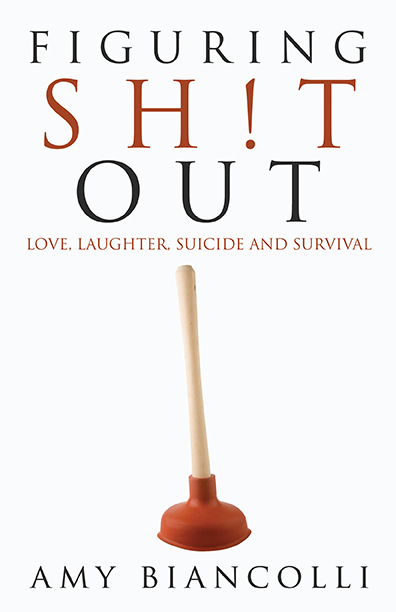
I have a publisher! Behler Publications, outside Pittsburgh! That really happened! And not only do I have a publisher, I have a cover! That happened, too! I know, I can’t believe it, either!

And not only that, both the publisher and the cover happened within less than a week. Four days, actually. About the time it takes to fly to New Zealand and back, which I’ve never done but would like to, someday, although I’d prefer time to chillax between the the two days there and the two days back.

When I told my dad (meaning Dan, my current father, as opposed to Louis, his late predecessor), he let out a celebratory whoop before reminding me that not so long ago I’d called him up at a low ebb and announced, flat-out, in the grating, nasally monotone of a woman who has gazed so far inside her navel she got her face stuck, that the book would never find a publisher. Ever.

“Remember what you said?” he asked me. “You said you were stupid for even believing it could happen.”

I know, I said. I remember.

“And remember, I said you were being an asshole.”

I remember that, too.

He smiled. He gives me such vast amounts of shit, and the more he gives me, the more I love him.

Even at that nadir, I was glad I’d written the book. Writing it was a gift. Writing it was restorative and transformative, profoundly so. I became someone new as I wrote it: freer of worry, fouler of mouth. Having lost my sister Lucy to suicide in 1992, I knew about grief in the aftermath, but I knew squat about losing a spouse and raising three kids alone. After Chris’s suicide in 2011, I was forced to reconfigure myself, suddenly and dramatically, in ways I could never have imagined. I still can’t imagine them all.

So the book has found a home. It’s due for publication this fall. And for the record: that classic rubbery plumbing device on the cover came straight from the fertile mind of my daughter Madeleine. We were plowing through Indian takeout, and between bites of chana saag, she said, “Mom. They should put a plunger on the cover!”

They should and they did. That really happened, too.