allegretto

mama and lucy
The other morning, while driving to work, I twirled the radio dial over to WMHT just as the announcer was cueing up the honeyed opening allegretto to César Franck’s A major sonata for violin and piano. I yelped quietly with thrilled anticipation. Yes. Yes. I turned up the volume. Gripped the steering wheel a little harder. Leaned toward the speaker. And there they came, those first, quietly inquisitive chords on the piano. That lovely, lilting answer on the violin. The dialogue that followed between the two instruments and their players (Jeremy Denk, Joshua Bell) was performed with an exquisite and subtle joy that made me weep.

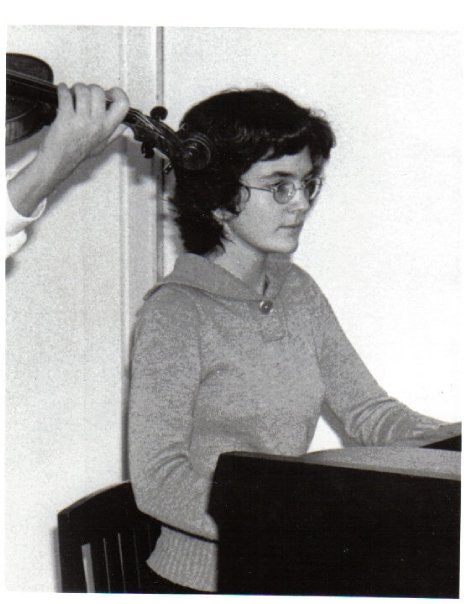
The Franck Sonata is one of those pieces that always prod my tear ducts into action. The last movement of the Sibelius Fifth is another. The Ode to Joy. The Moldau. A bunch more. But the Franck is special for me, because I first heard it one winter sometime in the mid-to-late 1970s, when my brilliant violinist-mom and just-as-brilliant pianist-sister started prepping for a recital together in the summer to follow.

It took place one breezy summer day in a barn-like hall in Litchfield County, Conn. They split the program between solo works — Beethoven for Lucy, Bach for Mama — and a duet. The Franck. It was the one piece that Lucy hadn’t memorized, so I had been recruited to turn pages. This was the only time I ever appeared on stage in any capacity with either of them, and the experience was transporting. I was terrified of screwing up. How could I not be?

And I did screw up, just once, early on: I was late on a turn, and Lucy had to reach up and whip the page herself in a blur of sudden motion. But my blunder didn’t stop them. They kept playing as though music were the only thing that mattered, lighting that allegretto and the movements that followed with a fierceness and a delicacy that carved out beauty from the air. And as those lush and liquid motifs spilled around us, the music overcame not just my fear but my ego, too, arousing within me a sense of art as something larger, more layered with meaning, more perfect than its most imperfect parts.

That performance of the Franck was the most beautiful work of art I’ve ever played a role in, no matter my feeble contributions. It still is. Nothing I’ve written comes anywhere close to it. It was the moment when I first spied the divine and felt myself a part of it, no matter my human fears and shortcomings. This is the gift of all great art.

So of course I never forgot that afternoon on stage with my mother and sister, two of the most profound musicians I’ve ever known and heard. And of course I’ve often pictured them together in Some Otherworldly Place on Some Otherworldly Plane drinking Otherworldly Tea, shooting it through their Otherworldly Noses as they cracked each other up with Otherworldly Awful Puns. Maybe, sometimes, they join in on Otherworldly Music with Otherworldly Instruments.

But until Monday morning, tooling along in tears as Denk and Bell became Lucy and Mama through the magic of radio, I had not imagined them playing the Franck in heaven. I think they must be. I think they have been all along. I think they were that day onstage in that distant Connecticut summer, when I screwed up, and they kept playing, and art transformed us all.

vita nuova

vita  nuova page 1

After my father tried to kill himself with sleeping pills in 1974, he spent nine days in a coma, attached to a snarl of tubes as his body and his brain flushed out the toxins. Then he spent six months in pure talk therapy at the Institute of Living in Hartford, Conn., where his mind and his spirit did their best to purge despair.

I remember visiting the place with Mama and my sister Lucy. The grounds were lovely and collegiate and lousy with overfed squirrels who ran right up to us and boldly demanded snacks. We would visit once a week, if memory serves, walking the grounds with my father, curling up on his bed with him (“Drink him up, girls”) and meeting fellow patients who called him Lou and smiled with thanks as he gave them candy. He always gave everyone candy; Daddy’s magic pockets were full of peppermints and crystal blues and doodads, rubber bands and paper clips and stamps.

One young man there truly loved him, gave him a copy of an Elton John album that my father never listened to (he was more of a Beethoven and Tin Pan Alley man) but I did. I remember huddling over a little blue record player, the kind that closed with a buckle, and listening to “Your Song” until the words entered my pores and then my bloodstream and finally my heart. I can’t hear that song now without thinking of Daddy, his time at the Institute, or the pale, sweet boy who gave him this record with the aching ballad of love and blue eyes (or green). I still have it somewhere. I’m not sure where.

I have other reminders of those days. The little ceramic rabbit he made in art, for one. For another: every memory of my father that followed his hospital stay. Because he came home. The talk therapy stuck. He was always a little strange after that, and the coma, combined with some other form of dementia, did a number on his short-term memory. But he never attempted suicide again. He lived another 18 years, dying at age 85 from heart failure after a fall.

Just tonight, digging through an attic drawer in search of a working pen, I found something else: Some of the notes Daddy made during those six months in Hartford. What caught my eye in particular were four small, pulpy sheets torn from a pad and covered with his idiosyncratic (to say the least), borderline-illegible handwriting. But it’s legible enough, this time. And it’s profound: a beautiful, powerful statement of life and hope from a man who had given up on both. Its title, I’m guessing, is an homage to Dante’s “La Vita Nuova” (“The New Life”), not surprising for an author who pored over the classics, worshiped the written word, worked his tongue at 16 languages and translated “The Divine Comedy” out of sheer love of poetry.

I cherish this little scribbled document — this determined scrabble of light and gratitude in the wake of terrible pain. It says all anyone has to say about the will and the need to keep moving and loving with purpose. I’m glad he lived to say it. I thank him for it. I love him for it. It gave him new life, and it gave me my father. It’s my Vita Nuova, too.

Vita Nuova
-To be grateful for every breath.
-To be interested in everything concerning and absorbing humanity.
-To be doing something or other, preferably constructive and progressive in development — but to be immersed.
-To learn to concentrate for longer and longer periods and perhaps always a little more fruitfully.
-To value every moment with my dear ones as a precious jewel, unique and irreplaceable.
-To be of help, in small or large matters, whenever possible among my fellows in other settings and gatherings.
-To get back, with new glasses — badly needed — to reading — linguistics, etc., anything, even murder mysteries, for puzzles and relaxation.
-Perhaps to plan a book about word origins, backgrounds and relationships.
-To be grateful for today — to dwell happily on the thoughts of tomorrow, and placidly on the problems of yesterday.
-To learn from my mistakes, particularly the MISTAKE, and know such impulsive, undermined behavior is completely buried in the past and beyond repetition.
-To be ever grateful for the love others bear me and return it with warmth and pride.
-TO LIVE! And to help others live more fully.


full house

As I write this, my three offspring and I are all under one roof. My roof. Theirs. Ours. The steep peaked number we’ve occupied (or two of us, at any rate) since the fall of 1993, the exact weekend when I was due to give birth to my oldest child. I was huge. Emphatically huge. HUGE HUGE HUGE HUGE HUGE. So huge that total strangers often commented on My Emphatic Hugeness, then followed it up with some comment about the twins or triplets or dodecatulpets I was storing inside, then followed THAT up with some OTHER comment, usually a choked expression of disbelief that I was only actually storing just the one. (NO WAY!! Are you SURE? Have you had an ultrasound? You have?!? I don’t believe it! Snort. Really? Ha! Gasp. Spit. Wow! HAHAHAHA.) This Emphatic Hugeness did not prevent me from playing basketball at the hoop that came with the house that my late husband, my large belly and I had just moved into. It was a habit I assumed in the hopes that all the repeat hoppity motion would perhaps joggle the baby out of its inertia and down the birth canal with a nice, wet, swift, gurgling whoosh.

Of course no audible whooshing occurred in the birthing of that baby or the two who followed. For a time, as the kids were growing, the three-story house shrank in size, filling up with the kids and their friends and their noises. Then they began to grow up and past the phase when all their friends, as well as their noises, spent so much time at home. They started to live some of their lives under roofs less steep. Then their father died, and the older two whooshed themselves right out of the house for most of the school year, and the resultant sucking sound almost deafened me. My youngest and I have managed pretty well; in the last several months I’ve become accustomed to schlepping and shopping and cooking for two, and we have our little nightly routines. He’s good company. I’m not complaining.

But it’s all so strange and novel, just as everything at every point in parenting is all so strange and novel. We use the word “newborn” to describe that squirming thing of beauty we rock and feed in our arms, but since when do our children stop being new, stop being born? When is loving them and watching them grow NOT a revelation? When is saying goodbye to them NOT a stab in the heart? People talk about the “empty nest” stage as though every stop short of it isn’t a major life adjustment. The first time you set them down for naps and leave the room: that’s killer. Then you hand them off to a baby sitter. Drop the dribble-nosed urchins at preschool. Kiss their heads, inhaling that sweet powdery perfume of childhood, on their first day of kindergarten. Say goodbye to them at summer camp. Trust their chaperones on an overnight field trip. Trust your teens behind the wheel when they first get their license. Watch them graduate high school. Watch them move into college. Watch them leave. Wait for their return.

One day they flock home, and the house fills up again with the kids and their friends and their noises — until, late at night, they curl up on their beds and breathe under a single roof.

It’s happening right now. And it’s huge.

re-re-re-re-re-re-re-birth

photo (45)
We dogged Judeo-Christians like to think of ourselves as linear. IN THE BEGINNING! AND THEN THERE WAS LIGHT! AND ON THE THIRD DAY! Even if we don’t take all that calendar-progression stuff literally (seriously, how long IS one of God’s days, anyway?), the Bible still piles on the highlights from one sequential event to another. So when we read about alternate, cyclical conceptions of time in other cultures and religions, we tend to think: Oooh-ee, wooh-eee, now THAT’S exotic! Just imagine! Time looping around for a re-do!

And then, lo and behold, Christians celebrate Christmas same time each year. Over and over, an unmarried teenager gets pregnant in the Middle East. Over and over, her boyfriend marries her anyway (a true miracle), and over and over, the impoverished, homeless, faithful couple wind up giving birth in a barn. And that’s not all that happens. When I attend midnight Mass, I can bank not only on Jesus’ birth but his entire Passion, too: the prayers that lead to the Eucharist mark his suffering, death and resurrection. Every Eucharist is a little Easter unto itself. And so, in the course of a single Christmas Mass, Jesus is born, eats his last meal with his friends, dies on the cross and rises again. That’s quite the life cycle.

Sometimes, sitting in Mass, I fall into a moment that feels like a snatch of timelessness, not a turn of a wheel, not a ticking second, but something illumined and profound. Believing, as I do, that God joined us and healed us in our brokenness the only way God could — by walking among us, drinking wine at our weddings and scraping his sandals in the dirt next to us until he bled and died — then why wouldn’t I also believe that he’s still here? In this very moment, and the next one, and the next? We’re still broken, right? We’re still walking. It’s not like we’ve perfected this mortal-living shtick of ours. We plod ahead with our blinders on, trying to see too far ahead and not pausing to feel the present. Why wouldn’t the God who’s always back for more just plod away beside us?

So Mary’s about to give birth. Jesus is about to arrive, howling for milk and warmth and love, finding it in the arms of his parents. He lives. He dies. He lives again. Amen, and Merry Christmas.

the mystery of the knees

Whenever I meet my maker, I’ll have two pressing questions at the ready.

1) Why are tooth size and palate size determined by two separate genes? Who approached you with THAT brilliant idea? Orthodontists?

2) Knees. Seriously?

I don’t actually expect answers. I’m not that much of an irreverent twit, or that bad of a Catholic, to think the Great Master Programmer in the Sky owes me an explanation. Also, evolution being what it is, the knees seem kind of necessary, at least at 6:55 in the morning, when I can’t very well locomote by dragging my hairy knuckles around the floor, because then I wouldn’t have one hand free for coffee.

But dag nab it, my left knee has been acting up lately. What a pain in the ass! Though technically it’s a pain in the genu, and no, I did not know that word until the Oracle of Google revealed it to me just now. Thanks to soccer and my damned bloody stupid (DBS) propensity for ignoring injuries, I have no one to blame for that knee but my own self. There are potholes in my cartilage that could snap the back axle on a Buick.

In any case, both the left knee and its less-crabby but still aggravating counterpart on the right like to remind me that I’m older than I was 30 years ago. No shit! I really am! The knees make me feel older than everything else about my body that telegraphs age, even the sagging bits and silver hair, because neither the the sags nor the melanin-deprived filaments sprouting from my head cause any actual physical pain. They don’t hurt when I stand after sitting, or when I sit after standing, or when I kneel, squat, plop down on the floor cross-legged, attempt a cossack dance or walk on pavement for eight hours a day six days straight, as I did a couple weeks ago in Edinburgh. Running is altogether out of the question, although I have been known to try it in short bursts of extreme DBS-ity and never fail to regret it. The most I do on a semi-regular basis is kick and juggle the soccer ball around with my kids, and even that puts that pissy little joint of mine in a problematic mood. It swells with anger afterward.

To combat it — when I remember — I swallow glucosamine tablets the size of my head, which might or might not work, but I’m leaning toward “might,” because even if they don’t work I want to believe they do work and thus coax from them a nice, agreeable placebo effect of almost-working. They certainly don’t hurt. As for the saggy and silvery bits, I ignore them.

Otherwise, I do love getting older. I love the way it gives me license to act like an eccentric old battle-ax and mouth off with random profanity at random moments while honking my nose into a crumpled tissue and reminiscing about the good old days of dial telephones (I HAD A PARTY LINE AS A KID, I SWEAR IT’S TRUE) and black-and-white TVs that got just one lone channel with crappy reception. I would much rather be this age than, say, 13, when the apex of my life was “Star Trek,” which aired every afternoon in reruns on the one lone channel with the crappy reception.

The sole thing I’d like to change, and probably will some day, is my left knee. I wouldn’t mind changing the right one, either. If I could go back in time, sneak up behind my younger self while she’s sitting cross-legged and drooling before a crappy monochromatic uni-channeled Captain Kirk, knock her unconscious, harvest a few cells from her knees, clone them, grow them in a petri dish, fortify them with multivitamins and motor oil, improve them with kick-ass bionic upgrades and then insert them into my legs, giving me not just painless knees but Super Mutant Turbo-Charged Nitro-Joints that bend painlessly and hit 90 on the NYS Thruway in 2.8 seconds, I would. But I can’t. Surgery isn’t quite there yet, though I’ve heard some Scandinavian doctors are getting pretty close. Maybe they can explain the mystery of the knees to me, if I ask nicely. But they still won’t know a thing about the teeth.

at a loss

glasses - sideways
Someday, loooong after I die and the house is emptied of its occupants and most its crap, archaeologists and/or real estate agents and/or intergalactic alien explorers with seven eyes and 18 tentacles will find piles and piles of reading glasses.

I lose these 1.50-power babies allllllll the time. Losing them has become such a familiar part of owning them that I regularly purchase them in bundles; I buy cheapo glasses at pharmacies, department stores, dollar stores (where one finds the cheapo-est), every freaking place they’re sold. Why, if vending machines spat out cut-rate spectacles, I’d buy them there, too. I buy them even when I already have a stack of ready-to-go reading glasses in the kitchen, because I know, sooner rather than later, I WILL LOSE THEM ALL.

Occasionally I relocate prodigal glasses; when that happens, I celebrate their return by dressing them in fine robes and slaughtering the fatted calf. Why, just tonight, I found a missing pair on my head. Last week I found two missing pairs on my head simultaneously — wow, what a find! A couple months ago, while cleaning the car, itself an occurrence as rare and miraculous as ball lightning or a lint formation in the shape of the El Greco Pietà, I stumbled across three whole pairs! Holy shit! And they weren’t even broken!”Someday,” said my perspicacious and observant son over dinner, “We’re going to find 50 pairs of glasses in this house.”

I lose other things, too. Pencils. Pens. Socks, of course — just one at a time. Gloves, also one at a time. Earrings. Tylenol. When I have glasses, my ability to read more than three sentences at night before falling asleep. Hair ties. Printer cartridges. Boxes of raisins. Bags of clementines (twice). Once, in the fridge, I lost a half gallon of 2-percent milk. Christmas wrapping paper. Knit hats, but never the ugly ones that no one wears. Spoons: one spring we lost so many we almost ran out, prompting my late husband to develop a Theory of Random Spoon Migration that involved house guests accidentally ferrying steel cutlery home in their pockets or nostrils or something.

When my kids were little they lost pacifiers, although I actually think they took a much more active role in binky-dispersal than they ever copped to. One of them, I won’t say which, had a habit of tossing the damn things out of the crib during nap time, then howling in outrage until mommy or daddy fetched it. Mommy and daddy always did. Mommy and daddy didn’t object until the day that daddy, leaning into a corner to retrieve the abandoned infant-suck implement, asked: “How’d that get there?” And the kid said, firmly: “The hand did it.”

I loved that response: what a great way to shirk responsibility for any action! I’m surprised Dick Cheney didn’t use that one when he shot the guy bird-hunting! The possibilities are endless, aren’t they? Napoleon on invading Russia: “The feet did it.” Miley Cyrus on twerking: “The butt did it.” Any public figure anywhere who says anything moronic about global climate change or sexual assault or Ebola or the president’s daughters: “The mouth did it.”

So when I lose my reading glasses, I know exactly what to say. The head did it.

my permanent gift

photo (43)
Today marks a year since I lost my best friend, Pam. I can’t believe it’s been so long. I can’t believe it’s gone so fast. I can’t believe I’ve made it 12 months without blabbing on the phone with her and laughing until my diaphragm rips in two. She held and helped me after my husband’s suicide. She talked me through moments of profound loneliness and aching doubt and crashing, crushing guilt. She told me that good things would happen, they would. That I’d find love again, I would.

After she died, I did. And I couldn’t call her up and tell her. I still can’t. Her absence felt like a rupture in the cosmic order of things. It still does. Several times a week, my brain howls at me to JUST PHONE PAM, and I explain to my brain that sorry, she’s unreachable, but the damn thing doesn’t ever listen. Instead it howls again, DIDN’T YOU HEAR ME? I SAID JUST PHONE PAM! And I can’t it shut it up. So I talk to her anyway, telling her about all the crazy joys and heady milestones that have come my way since her death.

I wonder what’s been happening at her end, these days. I wonder if she’s looking down at us, tracking everyone’s movements, whispering little directives to help us all along. Could be. Could also be she’s reading a book or singing a hymn or kicking a soccer ball around Somewhere Up There. Or doling out a few words of counsel to someone in her gentle, calm, comprehending way, which always felt less like advice than some humbly revealed wisdom of the ages. Or unleashing that high-pitched madhouse giggle of hers. Or smiling that beautiful, face-consuming smile, which spread the width of her cheeks and squinched up her eyes to slivered crescent moons. I used to wonder how she saw out of them. I used to wonder how she managed to see so deeply into me. How she saw so deeply into everyone.

I know she’s not far away; I believe that. I know she’s still Pam, only more so, and that we’re still friends; I believe that, too. To borrow a phrase from another dear friend, Toni, who lost too many sons: Pam is my permanent gift, just as everyone I love, in this life and in that one, is a permanent gift. And so she’ll remain, no matter the years that slip past in her absence, no matter the phone calls that fail between here and there. I’ll never stop talking to her. That’s part of the gift. For that, and for her, I’ll always be grateful.

at arthur’s seat

photo (42)
Last week, visiting my oldest on her semester abroad, my kids and I hiked Arthur’s Seat — the hill that looms like a mountain in the middle of Edinburgh. As we hoofed along the leafy path to its periphery, I thought of my last visit there in 1986 — at the close of a post-college year spent living, teaching, eating chips and tripping on cobblestone in the lovely gray eminence nicknamed Auld Reekie.

My sister Lucy had flown in for my last week in Edinburgh, and I brought her up Arthur’s Seat for one last view of that ancient and spooky and perpetually damp city. Heading back down, I almost died. I’m not exaggerating. When I say I almost died, I mean I LITERALLY ALMOST DIED, by which I mean I nearly fell +/- 800 feet down a near-vertical sandy face into a roadway. I’m certain I would have LITERALLY ENTIRELY DIED had Lucy not talked me down from a second height and a steeper one, my own vertiginous panic.

I was scrabbling at the sand and brush — madly, uselessly — after taking a wrong and wrongheaded shortcut down from the summit. For some reason, I won’t even attempt to explain why, I didn’t want to return by the proper footpath. And I wasn’t just scrabbling; I was scrabbling one-handed, as my left hand was busily gripping my precious umbrella. Early on during my year there I had learned not to leave the house without my brollie, and we had bonded, the two of us. We were inseparable. It was my best friend. I refused to leave it behind.

“Ame,” Lucy said. “Ame. Let go of the umbrella.”

No. I wouldn’t. No. I had bought it at a shop off Princes Street, and it was covered with sheep, and I wanted to bring it home with me. No.

“Ame. Let go.”

NO. NO. NO.

As my hand and feet slid against the sand and loose brush on the face of Arthur’s Seat, I started shouting. Hyperventilating. Freaking the hell out.

“Ame,” Lucy said again. She sounded calm. Facing the same sheer crag with the same loose dirt, the woman who had struggled for years with the urge to kill herself was relaxed and in control. Hundreds of feet below us, a police car pulled to the side. Two dots emerged and started waving their arms, an unmistakable gesture that said: GO BACK, DUMBASSES. IF YOU DON’T, YOU’LL LITERALLY ENTIRELY DIE.

“Ame. It’s okay. Slow down. Breathe normally.”

I can’t breathe normally.

“You can. You can.”

I tried.

“Now, see that bush? The one up there, by your head? Grab it. Let go of the umbrella and grab it.”

I wouldn’t let go of the umbrella. I wouldn’t.

“Grab it.”

I grabbed it, still clutching the umbrella.

“Ame. Now slowly. Use your other hand to grab that root over there. Pull up.”

I can’t.

“You can.”

I did. In this manner, one root and shrub at a time, she talked me up and away from danger. At the top I thanked her for saving my life, and she laughed. “No, I didn’t.” Yes, she did. She did. We both knew that she did. She saved my life.

Had I only been able to do the same for her six years later, when she swallowed a shitload of meds and curled up on her bed to die. Then she might have joined me on my return to Arthur’s Seat last week. She might have laughed at the summit with her “Little Amys,” a term coined by her shrink for the children he hoped I would have someday — anchors in the world for her to love. When I got married, he wanted me to start popping out babies immediately. He thought they might keep her alive.

A year and a half after Lucy’s suicide, my oldest was born. She never got to meet her Little Amys.

On an impossibly sunny afternoon, no brollie in hand, I emerged from the woods opposite Arthur’s Seat and stood at the base, staring at that same, sandy cliff, while my three miracles horsed around below. I asked them: Did I ever tell you guys the story about hiking Arthur’s Seat with Aunt Lucy? I had, but it was worth telling again. And as I did, it hit me: They wouldn’t be here if Lucy hadn’t talked me down that day. These Little Amys would never have been born. In a way, she had as much to do with their presence on this world as I did. Her role in their lives was just as generous, just as loving, just as real, and no matter that she never mussed their hair or pressed her lips to their foreheads.

I stood there weeping, but only for a moment. The kids asked if I was okay. Yes, yes, I assured them. I’m just grateful. I said a quiet thank-you to Lucy, picturing her bright purply-blue eyes and springy black mass of hair, and then hiked with my children to the summit. Auld Reekie looked as lovely as ever. Heading back down, we stuck to the path.

yes, ma’am

More people have been calling me “ma’am.” I’ve noticed this lately. More people have been offering to help with my groceries. I’ve noticed that lately, too. Of all the milestones and markers ticking off the years – having a colonoscopy, or being called “grandma” by a mouthy kid – this gradual, notable, not-objectionable uptick in the kindness of strangers hits me as the weirdest.

First: Because I’m not that old. I’m only 51! Gimme a break! It’s not like maggots are crawling up my nose! Sheesh! Second: Because, and I say this with some pride, I am actually pretty darned good at carrying groceries. If you saw me unloading my latest supermarket haul from the car and up the porch steps and into my house, gracefully juggling ten bags of Empire Apples and twelve jars of Nutella totaling fifteen tons from each of my mighty hands with their grips of steel, you’d say: “HoooooEEEEEE, girlfriend! You got some serioso muscles on you! Will you carry MY groceries?” Yes. You would say this. And you would not call me “ma’am.”

Third: Whatever age you think I am, I’m not. Inside I’m a 12-year-old. Inside I have always been a 12-year-old, and if you need proof, I point to the previously mentioned megatons of Nutella. At the same time, and this is going to sound well and truly bananas, I have always been an octogenarian, maybe a nonagenarian, possibly even a centenarian. At some point I may actually be an octogenarian, maybe a nonagenarian, possibly a centenarian, and if and when that happens, I give everyone around me express advance formal permission to carry all of my groceries anywhere they like.

But the old lady is in there, and she always has been. The hidden senior buried within me has perked up her lively and opinionated head at regular intervals, such as those moments in my youth when folks around me were super-high or super-drunk or some super-funky-and-adorable combo of both, alternately munching and puking away, and I inexplicably turned down the opportunity to be and do same. Not because I was moral or mighty or opposed to munching, but because I just wanted to go home and drink tea while watching “Magnum P.I.” with a blanket on my lap. I still have this urge, though I no longer watch “Magnum P.I.” Tom Selleck now bugs the crap out of me. But the tea-and-blanket impulse remains.

So maybe this is why young people (HAVE I REALLY STARTED CALLING THEM THAT?) are now addressing me as “ma’am.” It has nothing to do with my actual chronological age. When that kind bagger at the supermarket last week hefted the last of my groceries and asked if I “need help with those,” she wasn’t suggesting I couldn’t carry them myself. Nope. Of course not. She sensed mighty hands and their grips of steel. But she also sensed my urgent wish to sit down and blob with a hot beverage in front of the tube. It wasn’t the gray hair or the baggy smudges under my eyes or the unmistakable fog of exhaustion that tipped her off; it was the spirit of tea within me.

just doin’ my job

photo (41)Every now and then, I threaten to embarrass my children. I don’t often carry through on this threat, although I’ve inadvertently embarrassed them plenty over the years. Which is fine. As their mother, it’s my job to make them cringe on occasion. More than my job, it’s my duty, my métier, my calling. Singing in public once sufficed to embarrass them. Singing behind the wheel at a red light along with some moronic, auto-tuney, overproduced pop song while writhing to the beat in herky-jerkalicious nerd-o-mom convulsions still suffices, although they swear it doesn’t.

They also swear they HAVE NO MEMORY of those many times, recalled quite vividly by moi, when I and/or their late father danced in public. I remember doing so at the Victorian Stroll in downtown Troy one December. Right on Second Street, I think it was. The sight apparently caused the three of them so much physical and psychic pain that they blocked the memory for good, or at least until they undergo hypnotic regression therapy at the age of 50. (I see. . . my mother. . . . shaking her booty. . . near a hairy old man in jingle bells. . . someone, help me. . . )

I haven’t danced in the street in a while. What I do enjoy, on occasion, is expressing a desire to purchase some hideously awful item of clothing, especially shoewear, with the suggestion that I might actually walk around near people in it. I had some fun back in the mid-2000s when I declared an interest in purchasing rocker-bottom sneakers, and I was so convincing in this declaration that my No. 2 daughter howled NO NO NO NO NO NO NO NO until her eyes bled. I think. Or something like that. It was a little scary. And then, if I recall correctly, she made me participate in a pagan blood oath with sharp kitchen implements while I throat-sang I PROMISE NOT TO BUY SKECHERS SHAPE-UPS in Tuvan overtones.

I never did buy them. But last week, I was with her when  I saw this awesome pair of Adidas hi-tops, and I mean awesome, all tan and suede and ringed with fringe. Fringe! No fooling! On a pair of sneakers! David Crockett’s own, baby! Who wouldn’t want to wear those things?

Oooooooohhhh, I said as though I meant it (and I’m not saying whether I did). Ooooohhhh, look at these! I want them! I need them! I’m gonna buy them! Yes!

And my No 2. daughter howled NO NO NO NO NO NO NO NO. I think. Or something like that. Although her eyes didn’t bleed this time. Also, this time she added, just in case I didn’t get the point: MOM. IF YOU BUY THOSE, I WILL BURN THEM.

I didn’t buy them. The shoes had already served their purpose — and I’d already done my job.