dr. wisdom chimes in

NOTE: A blog reader has informed me that I was too hard on Dr. Wisdom — that the post below is too personal and mocking. Maybe it is. And maybe I should have left Dr. W. out of the conversation entirely.
But if my email exchange with this anonymous retired psychiatrist should serve any purpose, it’s this: to inspire us all to conduct our dialogue about mental illness in a manner both frank and civil. And anyone who believes we shouldn’t be talking about such things in public? Let them just go on believing it. It won’t affect us. We won’t stop talking.
Carry on.


Not so long ago, I received quite the imperious email from a retired psychiatrist. This had never happened to me before, although I did get an absolutely vile one from a hand surgeon years ago, after I gave a positive review to Michael Moore’s “Sicko.” The guy told me he despised me. In those words. Swell. I vowed not to have any fingers reattached by him any time soon.

By comparison, the letter from the shrink wasn’t vile, only arrogant — the sort of arrogance that feigns patronizing concern for one’s well being, a la, “Tsk, tsk, young lady, you shouldn’t be conducting yourself that way!” This came in response to a Times Union reprint of a blog post of mine exhorting people to talk about mental illness. In it, I mentioned my husband’s and sister’s suicides and my father’s attempt, all of which I’d written about before.

I was flooded with responses from readers describing their own and loved ones’ struggles with depression, bipolar, suicidality, addiction. Not a one took issue with my premise — that we need to talk about this scourge if we’re to have any hope of combating it — until I got the email in question.

It’s a stunner. It starts out expressing sympathy, then identifies the writer as “a retired psychiatrist who understands this subject better than most people.”

Ahhh. Dr. Wisdom. Nice to meet you.

I’m tempted to quote the email in its entirety, because it’s breathtaking in its presumption, pretensions and limited view of the world. The gist of it’s this: that Dr. Wisdom thinks I shouldn’t be airing out my woes in public. Thinks no one should. Thinks Facebook revelations are “pathetic.” Thinks we’re all better off discussing such things in private, with our closest friends and family and “a skilled professional” — like, say, Dr. Wisdom.

“It is unnecessary to satisfy everyone’s prurient interest in the details of one’s life. What kind of reaction are we looking for when we beat our chests to the world about how we have ‘survived’ this or that trauma or hardship? Admiration? Pity?”

According to Dr. Wisdom, we should always to turn a stoic, shiny face to outsiders: “I, personally, wish to be seen and appreciated for my strengths and I am careful to keep aspects of my life experience that may be viewed by others with pity or contempt confined to my private sphere of relationships, if at all.”

That’s an interesting word: “strengths.” Because I’m not so sure I have any, aside from the strength that comes from realizing I’m broken. Aren’t we all weak? Don’t we all get punched sideways and pushed flat? Doesn’t a sane and happy life come from facing that? Isn’t that the paradox of being human?

The email continues:

“The best place to work out one’s issues is within oneself. Don’t look for the world at large to validate you. The world is and has always been, at best a callous and, at worst a cruel place, and, no matter how we may protest or struggle against this, it is unlikely to change.”

I have nothing against psychiatrists or other mental-health practitioners, by the way. I regard them as I do all specialists — i.e., as people to be visited on an as-needed basis, like orthopedists. But, like orthopedists, some are better than others.

After reading the email, I decided I felt sorry for Dr. Wisdom. What a miserable and lonely way to go through life, convinced that you can’t reveal yourself to anyone but those in an airtight inner circle. How confining that is. And how useless. What’s the point of living if we don’t connect with others? What’s the point of pain if we don’t acknowledge it, reach out with it, start new conversations, find new commonalities, make new friends — and maybe help out someone in the process?

Good can come from bad. But only if we talk about it. Only if we share ourselves with others.

I did zap a reply to Dr. Wisdom, noting that my husband’s death was a news story covered throughout the region. And Dr. Wisdom did apologize, but only because mine was a public loss; that made my decision to write about it acceptable. (“I was referring in my note to those who feel the need to be the ones to spread the news, which does not apply in your case.”)

I didn’t respond to this apology. It wasn’t worth it. Dr. Wisdom wasn’t worth it. But the whole exchange reminds me, once again, that we have a long way to go in discussing mental illness with compassion — and without judgment — in a manner that helps everyone, patients and families alike.

I’m going to put this bluntly: Anyone has the right to talk about anything that happens to them. When trauma hits you, whatever shape it takes, whether it happens in public or private, however uncomfortable it makes other people, you bloody well own it. You can deal with it however you need to deal with it. You can stuff it down. You can see a shrink. You can air it out. You can talk about it, write about it, sing songs about it, make art about it, push for change on it.

You can decide what to do with your own pain. It’s yours.

i plunge, therefore I am

photo (25)

Proof positive that I found the right publisher for my nutcase little memoir coming out in September: this very gewgaw, a plunger from the island of Lilliput that arrived on my doorstep courtesy of Lynn, my editor at Behler Publications.

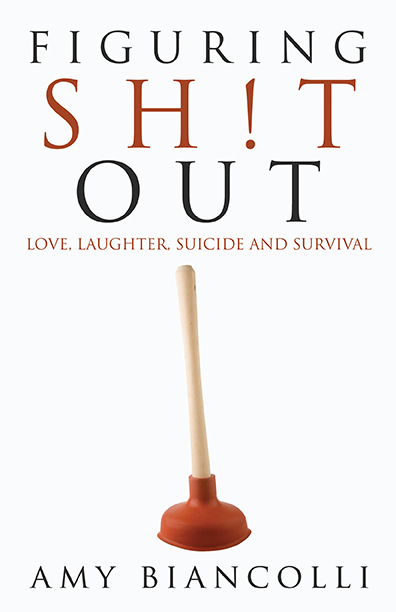
You’ll note a resemblance to the rubbery implement employed on the cover (and suggested by my daughter Madeleine):

sample 2B

Clearly, my book is in good hands. I don’t know what I love more, the wee tchotchke or the accompanying letter (“I saw this and thought of you!”), which suggests that I now remind people of shit and all devices related to its disposal. I’m the shit lady! Yes, I am! I wrote a whoooole book about the nature and disposition of poop, most of it figurative, emphasis on “most,” and then I started a blog about same. As a result, next time you see a plumber’s snake, your first thought might be that congested toilet you bravely unclogged with your bulging forearms at Thanksgiving, but your second will be me. Yup. Me.

And strangely, I am okay with this. No shit.

love won’t do that

love never fails
You know how things you see every day can smack you in the kisser in a new way? That just happened to me the other night. And how.

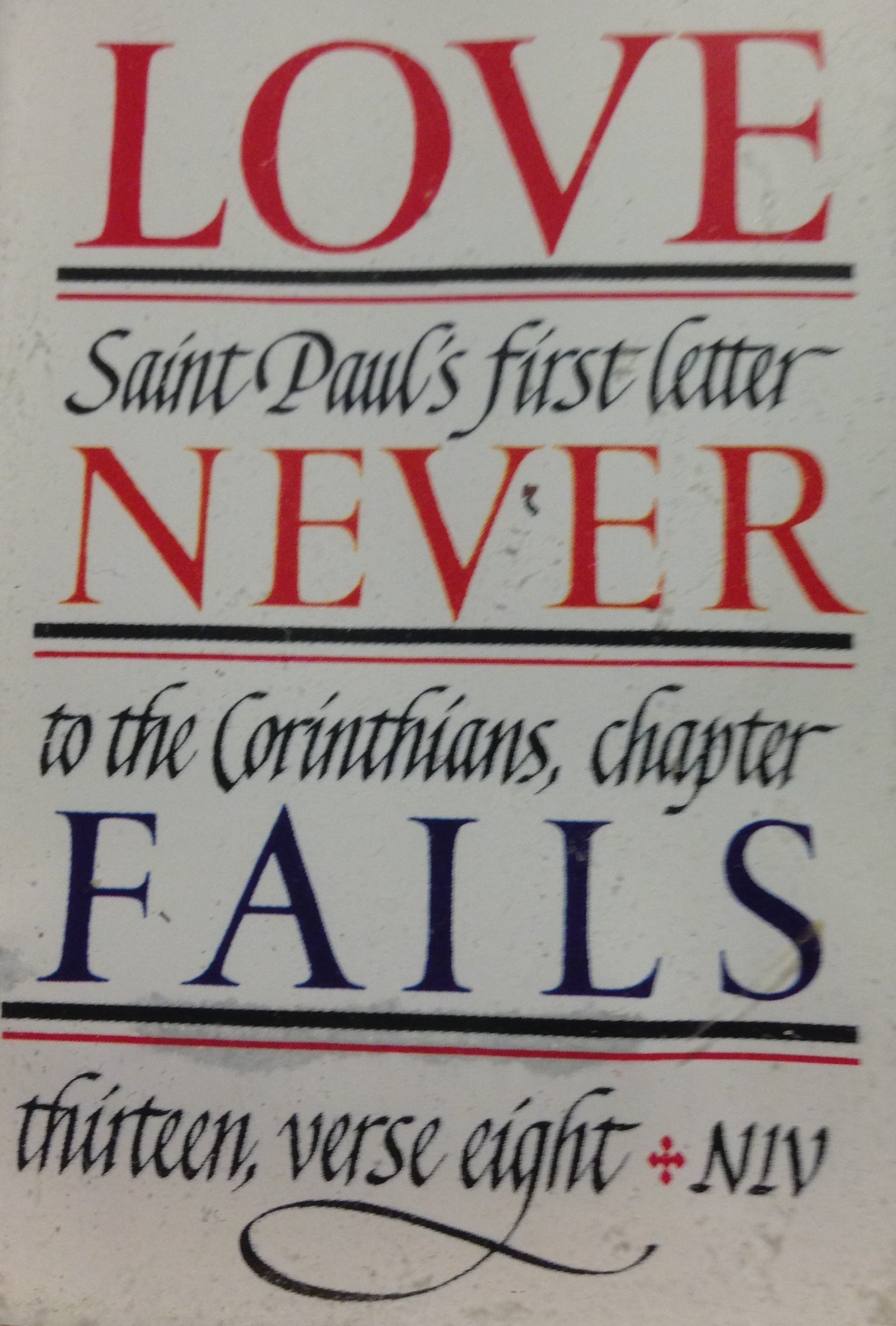
I’d bought the li’l framed knicknack at a dollar store years ago. Stuck it on my dresser. Looked at it every day. Absorbed its message, or so I thought.

“Love never fails.” If I were a biblical scholar, I would have realized that this is often translated other ways. If I were astute, I would have remembered hearing these other translations now and then. If I were only fractionally less spacey, I would have noticed that the remainder of that passage makes a big big big point of the ephemeral nature of prophesies, tongues, knowledge — basically everything in the world besides love.

But, well. I’m not any of those things.

“Love never fails.” So I had always interpreted this line as a testimony to the illuminating power of love, its ability to prevail over darkness. I believed this even though my own love hadn’t prevailed against the darkness that took my sister and my husband. I loved and loved and loved them. I tried and tried and tried.

And yet.

Suicide tests our faith in everything, most of all the force and gift our of own love. The guilt that slams the living in its aftermath springs from a sense of personal failure, impotency, inadequacy. What we could have done but didn’t! How we might have loved but failed!

“Love never fails.” But we’re not called to be successful. None of us is. We’re only called to give it our best shot — to love and love and love, to try and try and try. To hold out our arms when we see someone falling, even if we don’t catch them. Even if we fall, too.

I held out my arms for my sister and husband. Though I failed to catch them, I loved them as well and as deeply as I could, and I still do. My heart still fills with wonder and gratitude at the thought of them both — at the joy of being Lucy’s sister, Chris’s wife. The love I feel neither fizzles nor fades; it only waxes, never wanes.

This is what smacked me, one night at my dresser. It was so ridiculously obvious. I wondered how I’d missed it, all these years. It’s not that love will always heal a wound or stay a final restless act. It’s not about power. The eternity of love — the way it stretches from me to you and us to them, wherever we are, wherever they are, whatever seen or unseen fabric lies between us all — that’s the miracle.That’s the point.

“Love never ends.” It doesn’t.

my pal winter

winter pic

huh?

Earlier this week, as I was trekking through the windswept Times Union parking lot like Omar Sharif trekking through Siberia, my tragic inner wasteland reflected in my frosty beard and stricken cow eyes and eccentric, late-life obsession with bridge, I commented to the woman trekking alongside me that it was, ummm, cold.

What I said was: AHHHHH, IT’S COLD.

And what she was: AHHHHH, IT SURE IS.

And then I spouted the same crapo-philosophical pablum I almost always spout in such circumstances, which is: WELL, WE CHOOSE TO LIVE HERE.

And she said: HA HA HA, YES WE DO.

And I said: WE COULD LIVE SOMEWHERE ELSE, IF WE WANTED TO.

And she said: HA. YES WE COULD. BRRRR. HA.

At the time of this exchange, the temperature in the TU parking lot was a million degrees below zero. I told you my beard was frosty. But it had not yet begun to snow; that started later, a few hours before I was supposed to fly out of town to visit my oldest daughter but several damn hours after every damn flight was summarily canceled between here and there, and how else might I insert the word “damn” into this damn sentence?

I would like to blame winter for this turn of events, but that would be akin to blaming a cat for gracefully sticking its butt in my face when I’m trying to scratch it behind the ears. This is what winter does. Right now, it’s doing it really well. There is a million feet of snow in front of my house. I spent a million hours shoveling out this morning, even with the help of neighborly snow angels.

Another splat of philosophizing pablum I’ve been known to spew on occasion is this one: IF YOU LIVE HERE, YOU HAVE TO MAKE FRIENDS WITH WINTER. And this is true. I believe it. Winter is way easier to manage if you put your arm around its waist and give it a squeeze: go skiing, go skating, go sledding, and while you’re at it, wear lots of wool. Long underwear helps, too. And good boots.

But even my closest friends can be a pain in the arse on occasion, and this year, winter is getting on my nerves.

For instance: this is a transcript of our conversation this morning.

ME (shoveling): Well. My back hurts. You think you’re so cute, don’t you.

WINTER: What did you expect, grrrlfriend?

ME: I expected you to maybe take it easy on me. It’s not like I have ANYTHING ELSE GOING ON IN MY LIFE RIGHT NOW.

WINTER: What? Oh. I get it, Ms. Oh So Important Writer-Person. Like I’m supposed to, what, not dump 18 to 20 inches of snow on you because you’re revising your stupid book?

ME: I’m just saying.

WINTER: Oh, give me a break. I do this every year.

ME: Not like this!

WINTER (rolling its eyes): What a. . .

ME: Did you just call me a wuss?

WINTER (still rolling its eyes): You do choose to live here, you know.

ME: Screw you!

But a little while later, I took my son skiing at Catamount, and the heady whiff of fresh powder, cheap lift tickets and mild temperatures eased my grumbling a bit. Glancing from the slope over the snow-caked Berkshires, I had a second conversation with my friend winter.

ME: Gosh, you’re beautiful.

WINTER (batting its eyelashes): I was hoping you’d notice.

ME: You’re a lot of fun, too.

WINTER (giggling coquettishly): I know.

And I swear, my beard was melting.

the philosophy of mac & cheese

macaroni
Mmmm. Mac ‘n cheese. I am not a great cook, but I’m an effective one: i.e., my kids think of me as a great cook, and they will continue in this blissful, innocent, semi-delusional state until they’re a little older and much wiser and have supped at the tables of many and better cooks than I. This is a final stage in growing up, this culinary awakening, and it tends to occur somewhere in the early- to mid-20s. My oldest just cracked that decade herself. So I have a few years to go, still.

Tonight, as I set this dish of baked nirvana before my 13-year-old, he was one happy fella. If only all human needs were met so directly, and simply, and effectively, and with the same gluey profusion of melted cheese. He scooped it, splooshed ketchup on it (yes, when it comes to eating mac and cheese, we are People of the Sploosh), devoured it, scooped out more, splooshed more ketchup on it and then abruptly stopped.

Analyzing the be-splooshed squiggles of elbow macaroni occupying his plate, he noticed a problem. Something was way out of whack with the mac-to-sploosh ratio. He took another scoop.

“I have to even out the balance of ketchup and mac and cheese by adding more mac and cheese, because there was too much ketchup,” he explained.

Ah. Wisdom for life. Finding balance in all things.

“It’s like, if you have too much dressing on your salad, you add more salad to even it out.”

That sounds deep, I told him. There’s some profound truth embedded in there somewhere.

“Yeah,” he said. “It’s like, the mac and cheese is the good stuff in life, the happy stuff, and the ketchup is the bad stuff that happens, the stress.”

He picked up the ketchup bottle and waved it in the air for emphasis.

“So if you have too much stress, you add more of the good stuff to even it out.”

And what’s the good stuff? I asked him.

“I dunno.”

Like, laughter?

He shrugged.

Time with friends?

“Maybe.”

Or maybe we’re forcing this just a little, I said. Maybe the mac and cheese with ketchup is just mac and cheese with ketchup.

“I think so,” he said, and our graduate-level seminar in the Philosophy of Baked Pasta and Condiments came to a swift end.

But I didn’t think we were that far off. The only fallacy in the mac-versus-ketchup thesis is the element of control. In eating, we can dole out the bad and the good, the splooshing and the scooping, without any interference from outside agents; in life, the giant generic bottle of evil splooshes whenever and wherever it damn well pleases. But that only makes the macaroni that much more important, our determined scoops of joy offering our only real counterbalance to the ketchup.

Or not. Probably I’m over-thinking this. Probably it’s just food.

I shut up and ate.

the mess of an answered prayer

Do you ever pray for clarity? Or maybe just scrunch your eyes and hope for it hard, if you’re more secularly inclined? I do. Quite a bit. Mainly because I’m almost always clodding along in some murk or other, my poor, pointy head piled with dust bunnies that fog my sight and clog my thinking. Wait, correct that. Put quotes around “thinking.” Because what I’m actually doing is “feeling.”

So I’m always asking the Almighty for some handy-dandy clarification on some matter or other. I sent up one such request a few weeks ago, and while I won’t go into the specifics, the gist of it was: HELLOOOO, LORD! WILL YOU PLEASE LET ME KNOW WHAT’S GOING ON, HERE?! I’M SORTA KINDA CONFUSED! THANKS AND LOVE, AMY!

The Lord replied in no uncertain terms, and in a manner I did not particularly enjoy, over the course of several days. The celestial public address system blared out loud and clear: HELLOOOOO, AMY! HERE IS THE ANSWER TO YOUR PRAYERS. IT MIGHT MAKE YOU FEEL LIKE A BIT OF AN ASSHOLIC AND CLUELESS BOOB FOR A BIT OF A WHILE, BUT DON’T WORRY, YOU’LL FEEL BETTER IN THE END! HAVE FUN! HOPE YOU ENJOY IT! LOVE, GOD!

And in the end, it helped. I did find my clarity. I came out the sunny other side of a long, winding, dark, malodorous, garbage-strewn tunnel, and if it seems to you I might be describing a voyage through an alimentary canal, you’re absolutely right. At its conclusion I felt as though I had taken a really big dump.

I felt lighter. I felt free. I wept with gratitude and thanked the Lord. I’m not kidding about that part. I did both those things.

The whole experience served to remind me that God — or the universe, if, again, that’s where your faith lies — isn’t exactly prissy when it comes to helping out. Prayer dissemination isn’t quick n’ smooth, like some lofty milkshake that’s made at our request. (HI, LORD, IT’S AMY AGAIN. COULD YOU PUT AN EXTRA SCOOP IN THAT? AND MAYBE A SQUIRT OF CHOCOLATE SYRUP? THANKS!) More often, it’s a right mess; and when the object is clarity, we’re really in for it. The answered prayer can be a hard-fought battle, littered with misunderstandings and emotional complications of the sort we like to avoid.

And in the middle of it, I generally send up another prayer, either a sarcastic THANKS FOR THAT or an inquisitive IS THIS SOME IDEA OF A JOKE? One of the things that most amazes is me is that God never reaches down and cuffs the back of my head with an irritated grunt. I suppose, being omnipotent and secure about it, the Almighty can take my snotty back-talk without resorting to whoop-ass.

Anyway, it all worked out. Clarity achieved! But as the old saw goes, be careful what you wish for. You might get it, it might take longer than expected, and you’ll probably need a flashlight before it’s over.

freaks and geeks and pierre and natasha

Lately my 13-year-old son and I have been bingeing on “Freaks and Geeks,” the brilliantly crafted, deeply human high-school comedy-drama — I HATE HATE HATE the word “dramedy” — that’s set in 1980 and ran one whole season on NBC in 1999-2000. Its 18 episodes stream on Netflix. We are, as I write this, 19 minutes shy from being finished.

He keeps wanting to watch those 19 minutes; I keep procrastinating. I don’t want the show to be over. Its characters are too real, its scenarios too familiar, its emotions too nuanced and thorny and true. Some of its cast members became big deals on the big screen — James Franco as a sweet, dimwitted burnout, Seth Rogen as a joker with a heart of mush, Jason Segel as a scary-obsessive romantic — but the work they did on this show is as fine and affecting as anything they’ve done since. And the rest of the cast is just as memorable: Samm Levine, as a nerd in a sweater vest, looks, talks, cracks wise and comports himself like a minikin 40-year-old Borscht Belt comic. I love that kid. I love ’em all.

I’m sad just thinking about it. And I’m reminded of the gloom that began to set in as I approached the last 200 pages or so the first time I read “War and Peace” back in, jeez, what was it? The late 1990s? My late husband had been pressing me to read it from just about the day we met in 1990: “It’s like walking into a room,” he’d say, and I remember thinking, “What? A room? What kind of room? Isn’t it filled with ornately decorated tsarist furniture? And aren’t they all speaking Russian and have painfully long names?”

Actually, they’re all speaking French and have painfully long names. Don’t worry, I’m not going to regale you with them all, or the plot, or a detailed re-hashing of the Battle of Borodino, or even the moment when a plastered central character almost teeters out a window to his death — although I’m tempted. I am, however, going to point you to my friend Donna Liquori McGuire’s spot-on mash note to Tolstoy’s masterwork that ran recently in the TU and describes perfectly the hypnotic spell cast by that dense book, its breathtaking scope, minutely realized characters and gorgeous flushes of authentic, timeless emotion.

Once you get into it, you want it to go on forever. And at 1,250 pages, it does, in fact, go on forever. But those last 200! You don’t want them to end! I wanted Pierre, dear, awkward, decent Pierre, to fumble his way around Russia. I wanted ebullient Natasha to spark with sudden love. I wanted Nikolai to dally with hearts, and go off to war, and be a boy trying hard to be a man.

This is what I love about stories: When they work, they live. The characters quicken and stir. They walk around, they breathe within us, they speak. Finishing a great story, be it a thick Russian novel or a short-lived retro TV series, feels like saying goodbye. A kind of grief sets in. Those people and those places, once so real and alive, have settled into a hibernation — not quite a death — and can only be roused when someone new comes along and prods them all awake.

You can re-read and re-watch, but the second time feels less real than the first. We know what’s coming down the pike, for everyone. They’re all a little less there.

So, no. I don’t ever wanna watch the last 19 minutes of “Freaks and Geeks.” But my son is waiting downstairs for me — and off I go.

‘the moth’ and the egg

Well, this is exciting news here in the realm of Figuring Shit Out. I’m going to be on The Moth! Inside The Egg! Yep. The Moth, for those who don’t know, is a podcast and radio hour devoted to storytelling. The Egg, for those who don’t know, is a wackily-shaped performance venue at Albany’s Empire State Plaza. Whether it actually looks like an egg is open to debate. You can argue about it here, if you like. You can also listen to They Might Be Giants’ marvy song inspired by and devoted to it. See below.

“Lost and Found: The Moth in Albany” will take place at 8 p.m. Saturday, March 22, which I’m just now recognizing as William Shatner’s birthday, and wow, that’s an omen of some kind, right? That must mean something powerfully important, although I can’t imagine what, maybe some harmonic convergence involving orbs of influence and Jupiter in Aries or Uranus whatnot, but only if we all promise to pronounce “Uranus” as “UrANUS.” Or else it means I had such a brain-eating nerdalicious crush on him in 1976 that I memorized his birthday. You think? Is that it? That must be it.

Anyway, so I’ll be telling a story from my forthcoming book, “Figuring Shit Out: Love, Laughter, Suicide and Survival,” which concerns my husband’s suicide and aftermath and is due this fall from Behler Publications.

No word yet on ticket prices and suchlike, but I’ll post an update when I have more info, I promise.

Meanwhile, lend your ear to some “They Might Be Giants” tasty tunefulness. “Permission to land The Egg / Where should I stand? / The Egg, The Egg / No corners for youuuuuuuuu.”

luigi

jeanne and louis, early 60s

There they are: my late parents, lovely Jeanne and handsome Louis. He was 16 years her senior, 56 when I was born in 1963. Nowadays, not such a strange thing, to see an older parent at a school concert or a playground. Back then, it was peculiar enough that the news of my birth was met with amused relief by his assorted man-friends. “Hey, Lou!” they said, or so my mother reported to me many years later. “Good thing it’s a girl! Otherwise, you’d be out there throwing around a baseball in your 60s! Har har har!!”

To which I say: Har. Har. Har. Guess WHAT, knuckle-dragging sexists of the Neolithic? My father was out there throwing around a baseball in his 60s ANYWAY! In fact, he did that into his 70s! So there! Bronx cheer! Pppplllllllll!

But they didn’t know any better, really. Times were different. Sex roles were different. Fathers were different.

My father — Daddy, I called him — was a classical music critic and an author, co-author, editor or co-editor of a baker’s dozen of books. He was brilliant. He studied, read and spoke 16 languages, several fluently.

The eldest son of Italian immigrants, he embraced learning early on as a path to enlightenment and never abandoned it. He worshiped Beethoven, my mother and Thomas Hardy. He wore a beret morning, noon and night. He ate crystal blue mints and prunes, although not together. As a young man in Little Italy he sparred with his pal Big Lou Barba, but then Barba went punch-drunk and Daddy swore off prizefighting and violence forever. The only thing I ever saw him hit was a small bag at the back of our L-shaped porch in Connecticut, and when he did, our house rattled like the wrath of God.

He was a charismatic man. A sweet man. A terrible, terrible punster. (“I’m going for the mail.” Pause. “But not the female.” And he’d say this every single time he went to the mailbox.) He was a surprising man, too, offering to yield his patronymic to the matronymic because he thought “Mitchell” might be an easier name for his daughters to bear through life than “Biancolli.”

He was charming man; he once talked a mugger out of stealing his wallet (“Do you really want to? My late mother gave me that!”). He was a brave man; on the subway, he stopped a knife fight by laying his hands on the young men’s shoulders and saying, “brothers, brothers.”

He played the piano and the accordion by ear. His favorite song was “Melancholy Baby,” and he loved to belt it out in English and Neapolitan, his first language. He sang it for everyone who’d listen, including the friends and strangers he encountered on his walks around Lake Waramaug — walks he took every day, well into his 80s, long after his memory up and left him and everyone became a stranger, everyone became a friend. And as he walked, he swirled his arms, pumping out his Swedish calisthenics to a silent beat.

When he died, at the age of 85 in 1992, I imagined him as a young man — the young man I never met, strapping and sharp. I never knew that father. I never tossed a ball with that one. Sometimes, as a kid, I wondered what it might be like to have a conventional dad, one who still worked, who hadn’t struggled with depression and dementia, who wasn’t so often mistaken for my grampa.

But the one I had did his best. The one I had loved me, knew me, thought the world of me. The one I had smiled when I asked, “Daddy, can we play catch?” Even better, he said yes.

dark matter rocks

I love dark energy. Love it. Dark matter, too. I have no idea what they are, but it’d be weird if I did, because no one does, not even all those crazy-smart astrophysicists who hypothesize their existence. All anyone knows is, dark energy in all likelihood accounts for about 68 percent of the universe (68 percent! that’s a passing grade in some places!), and dark matter takes up 27 percent, leaving plain ol’ ordinary matter, the mundane, run-of-the-mill, observable, occasionally stinky crap, to take up a mere 5 percent. I won’t even venture a guess on how much of that 5 percent is found in McDonald’s value meals. A lot.

I’ve been Catholic for 24 years. Been a Christian for 30 or so. Believed in God for almost 40. Before that, following the lead of my atheistic father and agnostic mother, I believed only in the goodness of humanity and the largeness of creation. But I tell you what: those beliefs remain the essence of my faith. As frustrated as I am by my failure to see the future, as sidelined as I am by my tendency to fret, I’m relieved to know that I don’t actually know a thing. It’s a gift to realize the full scope of what I can’t see with my squinty eyes and hear with my whistling ears and grasp with my pointy head: at least 95 percent of all existence. That’s a shitload of stuff I won’t ever understand. Thank God! There’s more to life than value meals!

We can all agree on this point, right? Whether we believe in a deity or dark matter?

Me, I’m down with both. I don’t believe that science and faith are incompatible. Faith, to me, is not an obeisance to the known but an acknowledgment of the unknown, an abandonment to it, an against-all-odds conviction that a limitless Unseen lurks and envelops us. In describing the universe and its mysteries, scientists delve into that Unseen and assign it properties, laws, shape.

I assign it character, too. I assign it love. I can’t see it, but I’m sure it’s there.